
To develop AI for a business application, the process generally follows six stages: defining a specific, measurable use case, gathering and preparing the right data, choosing between a custom model, a pre-trained model, or an AI-agent approach, building and integrating the solution, testing it against real scenarios, and deploying it with ongoing monitoring. For businesses in Saudi Arabia, this process also needs to account for SDAIA’s data governance requirements and PDPL compliance from the earliest planning stage, not as an afterthought before launch.
Why AI Development Is Accelerating in Saudi Arabia
Artificial intelligence sits at the center of Saudi Arabia’s Vision 2030 economic diversification strategy, not as a side initiative but as core national infrastructure. The Saudi Data and AI Authority (SDAIA) was established specifically to govern how AI and data are developed and used across the Kingdom, and its presence signals something important: AI development here isn’t happening in a regulatory vacuum the way it might in less structured markets.
For businesses, this means the opportunity is real, but so is the expectation that AI systems handling Saudi user data are built with governance in mind from day one, not patched in before a compliance review.
How to Develop AI: Step by Step
Whether you’re building an internal automation tool or a customer-facing AI feature, the process breaks down into the same core stages, whether you build in-house or work with a development partner.
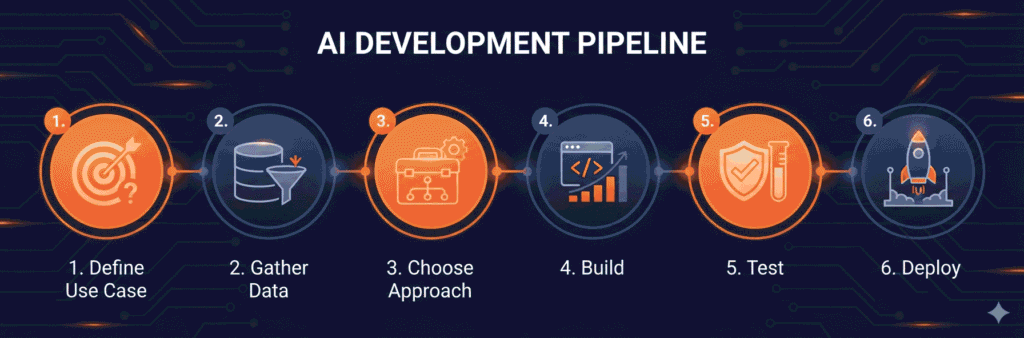
1Define a Specific, Measurable Use Case
The single biggest mistake in AI projects is starting with “we want to use AI” instead of a specific problem: reducing customer response time, flagging quality defects on a production line, or predicting inventory needs. A vague goal makes it impossible to know later whether the project actually worked.
2. Gather and Prepare the Right Data
AI systems are only as good as the data behind them. This stage means auditing what data you actually have, identifying gaps, and cleaning it into a usable format. For Saudi businesses, this is also the stage to build in PDPL-compliant handling: data residency, consent tracking, and access controls, rather than adding them after the model is already trained.
3. Choose the Right Approach
Not every AI project needs a custom-trained model. Three common paths: building a custom machine learning model (best for highly specific, data-rich problems), integrating a pre-trained large language model via API (fastest path for text, chat, or content-generation use cases), or building an AI agent that combines a language model with business logic and tool access (best for automating multi-step workflows). Choosing the wrong approach here is the most common source of wasted budget.
4. Build and Integrate
Development happens in iterative cycles, typically starting with a narrow proof of concept before expanding scope. This is also where the AI component gets connected to your existing systems, whether that’s a mobile app, a web dashboard, or an internal business tool.
5. Test Against Real Scenarios
AI systems need testing beyond standard software QA. This includes testing edge cases, checking for biased or inconsistent outputs, and validating Arabic-language performance specifically, since many AI models are trained primarily on English data and perform noticeably worse on Arabic without deliberate testing and tuning.
6. Deploy and Monitor
Launch is not the finish line. AI systems need ongoing monitoring for accuracy drift, especially as real-world data shifts over time. A model that performs well at launch can quietly degrade months later without active monitoring in place.
SDAIA and PDPL: What Saudi Businesses Need to Know
The Saudi Data and AI Authority oversees national data and AI policy, and its guidance shapes how AI systems handling Saudi user data should be governed. Alongside this, the Personal Data Protection Law (PDPL) sets requirements around data residency, consent, and security that directly affect how AI systems can collect, store, and process information.
In practical terms, this means AI systems built for the Saudi market should be designed with data residency options, clear consent mechanisms, and audit trails from the start. Retrofitting compliance into an AI system after it’s already built and trained is significantly harder than designing it in from the first architecture decision.
Real Use Cases Across Saudi Industries
AI development looks different depending on the industry and the problem being solved.
- Manufacturing: Predictive delay detection and automated quality reporting, the kind of AI risk and analytics capability built into our manufacturing ERP solutions for factory-floor visibility.
- Construction: AI-driven risk scoring and delay prediction across large, multi-phase projects, a feature built into our construction management software for giga-project coordination.
- Healthcare: AI-assisted patient flow management, helping hospitals anticipate bed occupancy and staffing needs, part of what we build into hospital management systems.
- Customer service: AI-powered chat and support automation, reducing response times for customer-facing teams handling high inquiry volumes.
Custom Model vs Pre-Trained AI: Which Do You Need?
This decision shapes both cost and timeline more than almost anything else in an AI project. A custom-trained model makes sense when your problem is highly specific and you have enough quality data to train on, think predictive maintenance based on years of your own equipment sensor data. Integrating a pre-trained large language model makes sense for most text, chat, and content-related use cases, where building a model from scratch would be unnecessary and far more expensive than it needs to be.
Most business AI projects in Saudi Arabia today lean toward the second path: integrating and customizing existing AI capabilities rather than building foundational models from the ground up, which keeps both cost and timeline realistic for most organizations.
Common Mistakes to Avoid
- Starting without a specific goal. “Add AI to our product” is not a use case. A specific, measurable problem is.
- Ignoring Arabic-language performance. Testing only in English and assuming Arabic will work the same way often leads to poor real-world performance.
- Treating compliance as a final step. SDAIA and PDPL considerations built in from the start are far cheaper than retrofitting them after launch.
- Overbuilding. Training a custom model when a pre-trained AI API would solve the problem faster and at a fraction of the cost.
- No monitoring after launch. AI accuracy can drift over time. Without monitoring, a project that worked well at launch can quietly stop working well months later.
What Does AI Development Cost?
Cost varies more with AI projects than with most traditional software, largely because the range of approaches is so wide. A few real factors shape the number more than anything else: whether you’re training a custom model or integrating an existing one, how much data preparation and cleaning is required, and how deeply the AI needs to connect into existing systems.
Integrating a pre-trained model for a well-defined task, like an AI-powered chat assistant or automated content tagging, sits at the more accessible end. Custom model training, particularly when it requires significant data collection and cleaning beforehand, sits meaningfully higher, both in cost and in timeline. Ongoing monitoring and retraining also need to be budgeted as a recurring cost, not a one-time expense, since AI systems generally need more maintenance attention than static software.
Building In-House vs Working With a Development Partner
Some organizations, particularly larger enterprises with existing data science teams, build AI capability in-house. For most businesses, though, working with an experienced development partner is faster and lower-risk, particularly for a first AI project. A partner who has already navigated SDAIA guidance, PDPL requirements, and Arabic-language model performance issues avoids mistakes that are expensive to learn firsthand on a first attempt.
Frequently Asked Questions
How long does it take to develop an AI solution?
A focused proof of concept can often be built in 4-8 weeks. A full production AI system, including testing, compliance review, and integration, typically takes 3-6 months depending on complexity.
Do I need a custom AI model, or can I use an existing one?
Most business use cases, especially text, chat, and content-related tasks, are better served by integrating and customizing a pre-trained model rather than building one from scratch. Custom models make sense for highly specific problems with large amounts of proprietary data.
What does SDAIA require for AI systems in Saudi Arabia?
SDAIA oversees national data and AI governance, and AI systems handling Saudi user data should align with its guidance alongside PDPL requirements around data residency, consent, and security from the design stage.
Does the AI need to work well in Arabic?
Yes, for most Saudi-market applications. Many AI models perform noticeably better in English by default, so Arabic-language testing and tuning should be a deliberate part of the development process, not an assumption.
How much data do I need to develop AI?
It depends heavily on the approach. Custom model training typically needs substantial, high-quality data. Integrating a pre-trained model for tasks like chat or content generation often needs much less data, sometimes none at all, beyond configuration and testing.
Can AI be added to an existing app or system?
Yes. AI features are commonly integrated into existing mobile apps, websites, or business systems rather than built as standalone products, connecting to current workflows rather than replacing them.
What happens after the AI system is deployed?
Ongoing monitoring is essential. AI accuracy can drift as real-world data changes over time, so a deployed system needs regular evaluation, not a one-time launch and forget approach.
Ready to Develop AI for Your Business?
From defining the right use case to SDAIA-aware deployment, we help Saudi businesses build AI that actually solves a real problem. Explore our full AI and software development services or get in touch to discuss your project.احصل على استشارة مجانية