Dallas businesses are investing heavily in mobile apps. And most of them are choosing React Native to do it. One codebase. Two platforms. Lower cost. Faster launch.
This guide gives you the direct answers you need. No fluff. See our complete mobile app development guide 2026 for the full picture.
What Is React Native and Why It Matters in 2026
React Native is a framework by Meta. It lets developers build iOS and Android apps from one JavaScript codebase.
You write the code once. It runs on both platforms. Users get a real native experience, not a web wrapper.
According to the Stack Overflow Developer Survey 2024, React Native remains one of the most used mobile frameworks worldwide.
In 2026, it is even stronger. Meta’s New Architecture upgrade makes it faster, smoother, and more compatible with native device features than ever before.
Benefits of React Native for Dallas Businesses
- One codebase, two platforms. Up to 90% shared code between iOS and Android. Cuts build time significantly.
- Faster launch. Ship your app sooner. Critical for Dallas startups competing in fast-moving markets.
- Lower cost. One team handles both platforms. You do not pay for two separate development efforts.
- Full native features. GPS, camera, push notifications, biometrics, Bluetooth. All accessible.
- Strong local talent. Dallas has a growing pool of JavaScript and React Native developers. Hiring is easier here than in most U.S. cities. Events like Dallas Startup Week keep the community active.
React Native vs. Other Frameworks in 2026
See full details in our best mobile app development languages 2026 guide.
React Native vs. Flutter
Flutter is fast and visually consistent. But it uses Dart, a less common language. React Native uses JavaScript, which most Dallas dev teams already know.
React Native vs. Native (Swift and Kotlin)
Native gives the best performance. It also doubles your team, your budget, and your timeline. For most Dallas businesses, the difference in performance is not noticeable to the end user.
React Native vs. Ionic and Capacitor
Ionic wraps a website inside an app. React Native renders real native components. The user experience difference is clear.
React Native vs. .NET MAUI
MAUI suits Microsoft-heavy enterprises. Outside that ecosystem, React Native has a far larger community and library support.
Quick Comparison
- React Native: Best balance of cost, speed, performance, and talent. Best for most Dallas businesses.
- Flutter: Great for pixel-perfect UI. Best if your team knows Dart.
- Native: Highest performance. Highest cost. Best for complex platform-specific apps.
- onic: Fastest to build. Best for simple, low-traffic apps.
- .NET MAUI: Best for Microsoft enterprise environments only.
Industries Using React Native in Dallas
- Healthcare. Patient portals, telehealth apps, appointment tools. UT Southwestern and Baylor Scott and White partners are active in this space.
- Real Estate. Property search, virtual tours, agent platforms. DFW is one of the most active real estate markets in the U.S.
- Logistics. Driver apps, warehouse tools, fleet tracking. Dallas is a major U.S. distribution hub.
- Fintech. Banking apps, payment tools, expense trackers. Dallas fintech is growing fast.
- Retail and eCommerce. Shopping apps, loyalty programs, POS tools.
- Food and Hospitality. Ordering apps, delivery platforms, hotel concierge tools.
Best Practices for React Native Development
Read our mobile app development lifecycle stages guide for the full process.
- Define scope first. No code before your core features and target users are locked. Scope creep kills budgets.
- Use TypeScript. It is the 2026 standard. Fewer bugs. Cleaner code. Easier hiring.
- Build reusable components. Saves time at every future update cycle.
- Optimize performance early. Use Flipper and React DevTools during development, not after launch.
- Test on real devices. Emulators miss device-specific bugs. Always test on actual iOS and Android hardware.
- Secure sensitive data. Especially critical for Dallas healthcare and fintech apps. Use secure storage, certificate pinning, and regular audits.
- Plan App Store submission. First-time reviews can take one to three weeks. Build that into your timeline.
How to Hire React Native Developers in Dallas
Full hiring framework: how to build a mobile app development team.
Core Team Roles
- React Native developer (or small team for larger projects)
- UI/UX designer with mobile experience
- QA engineer
- Project manager or product owner
- Back-end or full-stack developer for complex features
Where to Find Talent in Dallas
- LinkedIn jobs filtered to Dallas, TX
- UT Dallas, SMU, and Texas A&M Commerce recruiting
- Local developer Meetup groups and Dallas tech events
- Dallas-based React Native agencies
- Upwork, Toptal, Arc.dev for remote or contract talent
What to Look For
- Strong JavaScript and TypeScript skills
- React Native New Architecture experience
- State management knowledge: Redux, Zustand, or React Query
- Published apps on both App Store and Google Play
- Real portfolio, not just demo projects
Freelancer vs. Agency vs. In-House
- Freelancer: Good for small, defined projects. Lowest cost.
- Agency: Faster to start, full team ready. Good for MVP launches.
- In-house: Best for long-term products. More control, deeper knowledge over time.
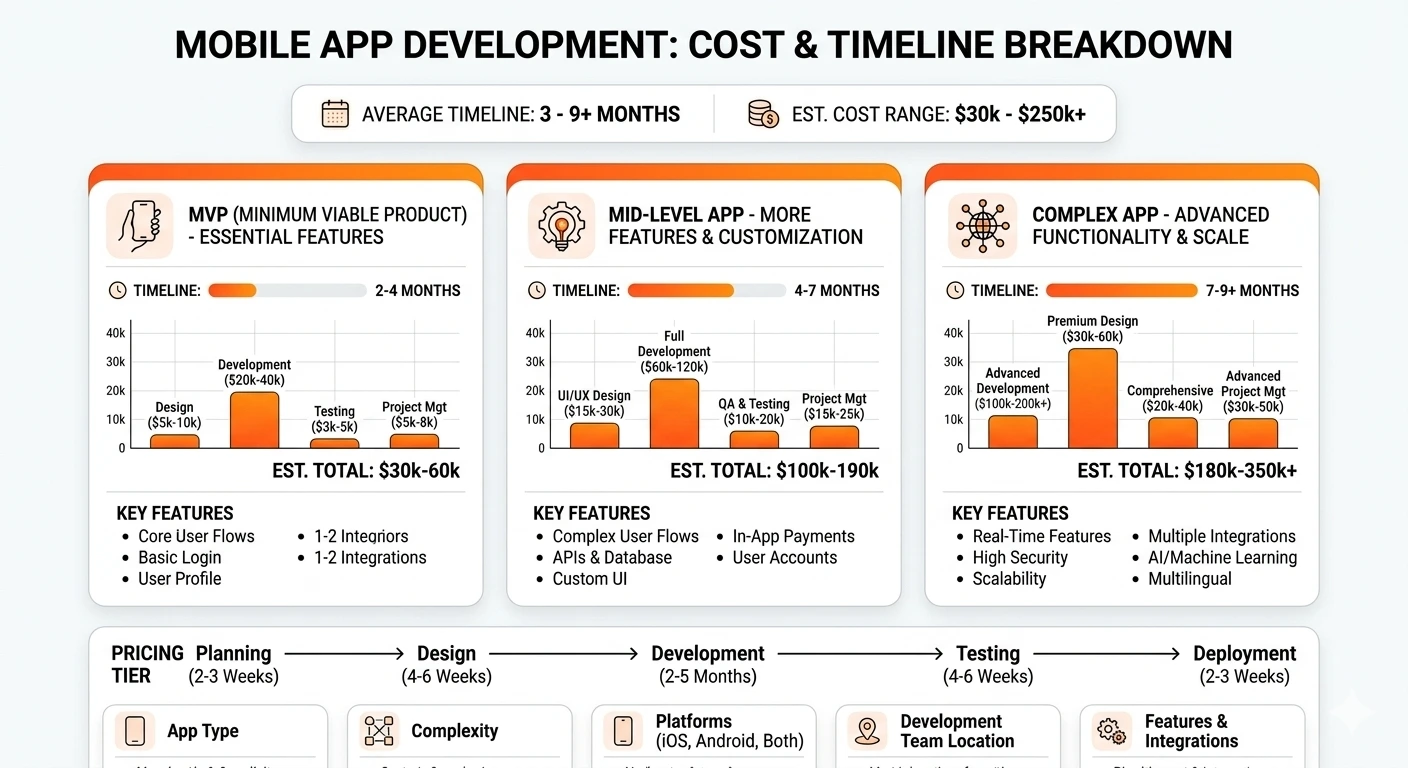
Cost and Timeline for React Native Projects in Dallas, 2026
Cost Ranges
- Simple MVP: $25,000 to $60,000. Basic features, standard back end, simple UI.
- Mid-Complexity App: $60,000 to $150,000. Auth, payments, push notifications, API integrations.
- Complex App: $150,000 to $400,000 and above. AI features, deep native integrations, enterprise-grade security.
Timelines
- Simple MVP: 8 to 14 weeks
- Mid-Complexity: 16 to 30 weeks
- Complex App: 6 to 18 months
What Drives Cost Up
- Senior developers vs. junior developers
- Custom design vs. standard UI components
- Number of third-party integrations
- Post-launch support and maintenance
Dallas React Native developers typically charge $85 to $165 per hour. Agencies usually offer project-based or monthly retainer pricing.
Future Trends: AI and React Native in 2026
- AI features are standard now. Chatbots, smart search, personalization, image recognition. Dallas healthcare, retail, and logistics apps are leading adoption.
- On-device AI. TensorFlow Lite and Apple Core ML let apps run AI directly on the phone. No data sent to the cloud. Critical for HIPAA-sensitive Dallas healthcare apps.
- New Architecture is production-ready. JSI replaces the old bridge. Faster native module communication. Real-time and animation-heavy apps are now practical in React Native.
- LLM integration. OpenAI and Claude APIs are being embedded into mobile apps for text generation, summarization, and smart assistants.
- Expo Router is the new standard. File-based navigation borrowed from the web. Faster development, easier maintenance.
- Cross-platform expansion. React Native now targets Apple Watch, Windows, and macOS. One team, more platforms.
React Native is the right choice for most Dallas businesses building a mobile app in 2026.
It saves money, ships faster, and delivers real native quality on both iOS and Android.
The Dallas talent pool is there. The ecosystem is mature. The cost is manageable.
Frequently Asked Questions
Yes, you can build mobile apps using React Native, a framework that uses React concepts and JavaScript or TypeScript to create applications for iOS and Android. React itself is primarily used for building web user interfaces, while React Native is designed for native mobile app development.
React Native offers code sharing across iOS and Android, reusable components, a large developer community, and access to native device features. These benefits can help businesses reduce duplicated development work and maintain their apps more efficiently.
React Native and Flutter are both popular cross-platform development frameworks. React Native is a strong choice for teams familiar with JavaScript and React, while Flutter uses Dart and offers a consistent UI rendering approach. The better option depends on the app’s requirements, team expertise, performance needs, and budget.
The cost of developing a React Native mobile app depends on its complexity, features, design, backend integrations, security requirements, and development team’s rates. A basic app generally costs less than an application with real-time functionality, payment systems, or complex third-party integrations. A detailed project scope is needed for an accurate estimate.
Yes, React Native can support large-scale business applications when the app is designed with a scalable architecture, secure APIs, appropriate testing, and ongoing maintenance. However, applications that rely heavily on specialized hardware or intensive processing may require additional native development.