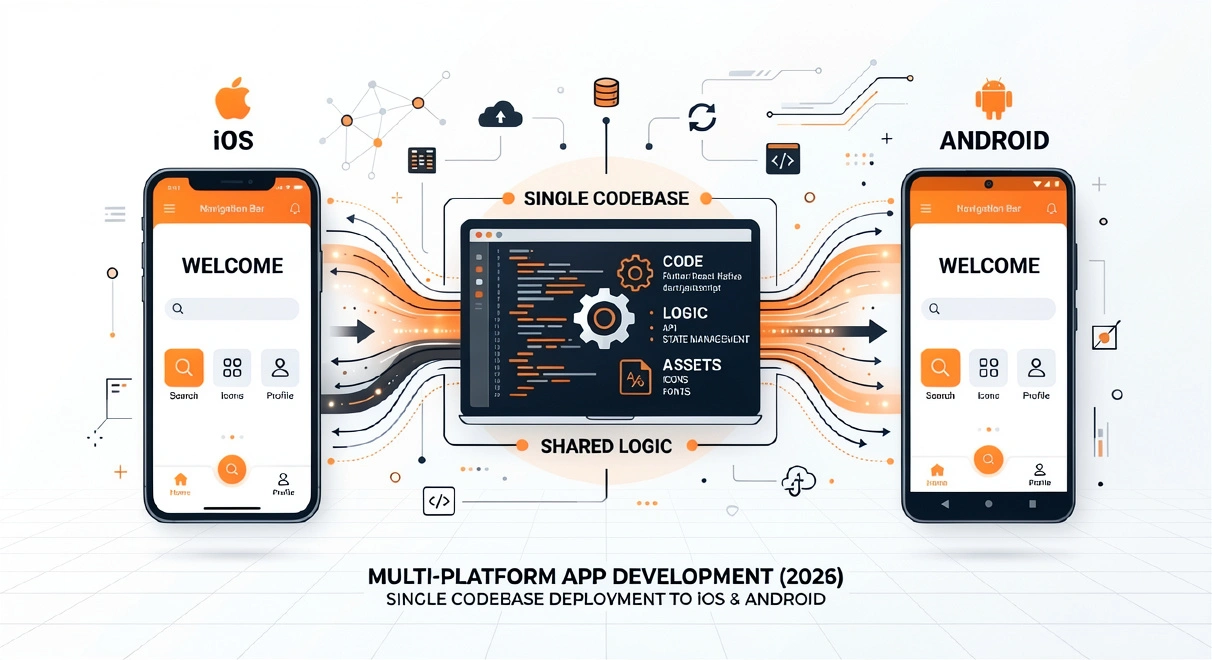
Most businesses today cannot afford to build separate apps for iOS and Android. That is expensive, slow, and hard to maintain.
Cross-platform and hybrid app development solves this. You write the code once and it runs on both platforms. In 2026, this approach has become the default choice for startups, scale-ups, and even enterprise teams.
The mobile market has matured. Users expect fast, polished apps. And businesses expect lower costs and faster delivery. Cross-platform frameworks have evolved to meet both demands without forcing a painful tradeoff.
This guide covers everything you need to know, whether you’re a business owner making a product decision or a developer looking for the right framework.
What is Cross-Platform App Development?
Cross-platform app development means building a single app that works on multiple operating systems, typically iOS and Android, using a shared codebase.
Instead of building two separate apps, your team writes code once and deploys it everywhere. Frameworks like Flutter and React Native make this possible by compiling the shared code into platform-specific interfaces.
Flutter, developed by Google, uses the Dart language and renders its own UI widgets. React Native, backed by Meta, uses JavaScript and maps components to native platform elements.
Both approaches have matured significantly. The performance gap between cross-platform and native apps is now small enough that most users cannot tell the difference.
What is Hybrid App Development?
Hybrid apps sit inside a native shell and run web-based code, typically HTML, CSS, and JavaScript, through a WebView. Frameworks like Ionic and Apache Cordova are common examples.
This is different from cross-platform. In cross-platform development (Flutter, React Native), the app compiles to near-native code. In hybrid development, the app essentially runs a mini browser inside the native shell.
Hybrid apps are cheaper and faster to build but tend to feel slower and less polished than cross-platform alternatives. They work well for simple enterprise tools, internal apps, and content-heavy use cases where peak performance is not critical.
If you are comparing options, the distinction matters. Hybrid gives you more speed to market. Cross-platform gives you a better user experience.
Cross-Platform vs Native vs PWA
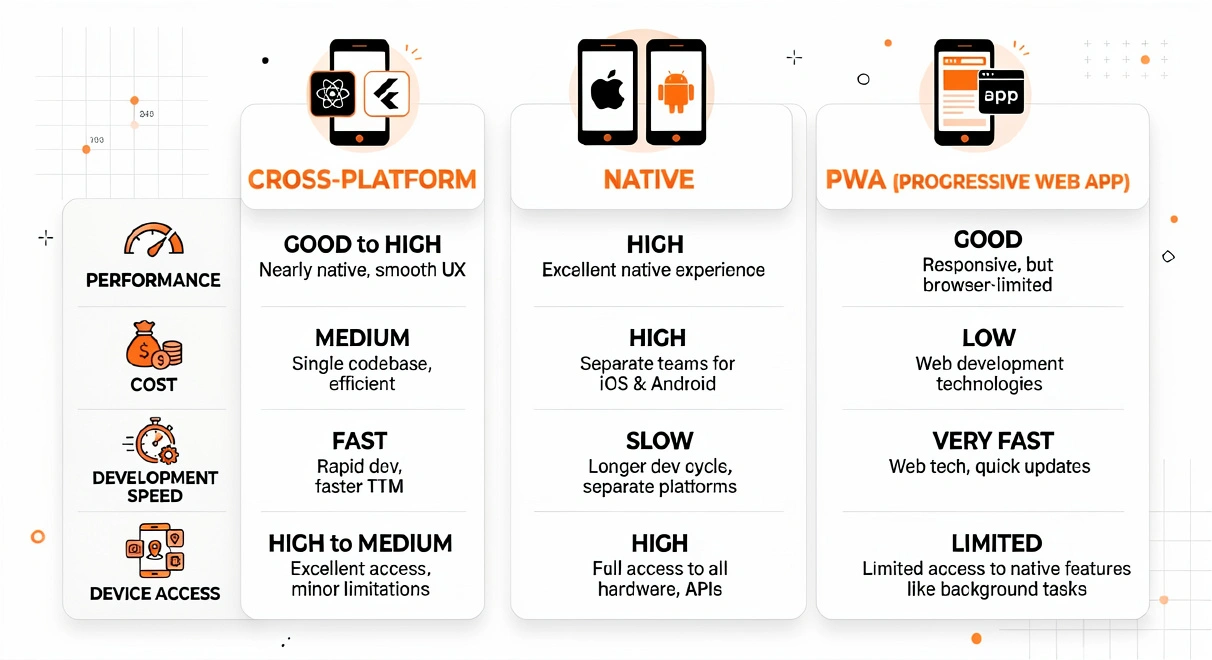
Choosing the right approach depends on your product, budget, and audience. Here is a quick breakdown of the three main options:
| Factor | Cross-Platform | Native | PWA |
| Development Cost | Lower (single codebase) | Higher (separate teams) | Lowest |
| Performance | Near-native (Flutter) | Best | Moderate |
| Time to Market | Faster | Slower | Fastest |
| Device Features | Most supported | Full access | Limited |
| Offline Capability | Yes | Yes | Partial |
| App Store Ready | Yes | Yes | No (mostly) |
| Best For | Startups, SaaS, MVPs | High-performance apps | Content, e-commerce |
For a deeper look at the trade-offs between web and native, read our native vs progressive web apps comparison. It covers performance, discoverability, offline behavior, and which model fits different product types.
Why Businesses Prefer Cross-Platform in 2026
Cost Efficiency
Maintaining one codebase instead of two cuts development and QA costs significantly. You also need a smaller team. One set of developers handles both platforms, which reduces hiring and coordination overhead.
Faster Development and Time to Market
A single codebase means faster feature rollouts. You push an update once and it goes live on both platforms simultaneously. For startups racing to validate ideas, this speed advantage is critical.
AI Integration Trends
In 2026, AI features have become table stakes for many apps. Cross-platform frameworks are keeping pace. Flutter and React Native both support on-device AI via TensorFlow Lite and Core ML bridges. The AI development ecosystem around these frameworks has grown rapidly.
Google and Meta continue to invest heavily in their respective frameworks, and the developer communities behind them are massive. This means more plugins, more AI integrations, and faster framework updates than ever before.
Popular Cross-Platform Frameworks
The framework you choose shapes your app’s performance, developer experience, and long-term maintainability. Here is a brief overview of what’s leading in 2026:
- Flutter: Google’s framework using Dart. Best rendering performance and the most consistent UI across platforms.
- React Native: Meta’s JavaScript-based framework. Large talent pool and easy integration with existing web teams.
- Kotlin Multiplatform: Share business logic across platforms while keeping native UIs. Popular in enterprise.
- Capacitor and Ionic: Best for hybrid apps. Built on web technologies. Good for internal tools.
- .NET MAUI: Microsoft’s cross-platform framework for C# developers. Gaining traction in enterprise Windows shops.
For a detailed breakdown of each option with use case recommendations, read our guide on top cross-platform app development frameworks.
What Most Guides Do Not Tell You
Most content on cross-platform development focuses on the benefits. Here are the realities that matter more for long-term success.
Long-Term Maintenance Cost Reality
The initial build is cheaper. But over time, platform updates from Apple and Google require constant framework adjustments. If you choose a framework with a small community or slow update cycle, your maintenance cost rises fast.
Flutter and React Native have strong backing, but smaller frameworks can lag behind by months when iOS or Android ships a major update. That lag costs real money.
Performance on Low-End Devices
Your most loyal users in emerging markets often use entry-level Android phones. Flutter performs better here than most alternatives because it does not rely on the system UI, it renders its own widgets. React Native has improved but can still struggle with complex animations on older devices.
If your target market includes price-sensitive geographies, this matters more than most benchmarks suggest. Test on real low-end hardware, not just emulators.
Hiring Challenges Globally
React Native developers are easier to find globally because they come from web development backgrounds. Flutter developers are in shorter supply but growing fast, especially in Asia and Eastern Europe.
Your framework choice affects your ability to hire, onboard, and scale your team. Budget for higher contractor rates if you go with Flutter in markets with low Flutter adoption.
Hidden Scalability Issues
Cross-platform frameworks handle most use cases well. But complex apps with heavy real-time data, advanced animations, or deep hardware integrations can run into walls.
Video editing apps, high-frequency trading dashboards, and AR-heavy applications often need native modules anyway, which adds complexity. Plan for this if your roadmap includes feature-intensive use cases.
When Cross-Platform Development Fails
Cross-platform is not always the right call. Apps that require direct Bluetooth Low Energy access, heavy GPU processing, or deep system-level APIs sometimes need native code regardless of your framework.
The smart approach is not to ask whether cross-platform works, but where it stops working for your specific product and whether that threshold matters for your roadmap.
Flutter vs React Native: A Quick Overview
These two frameworks dominate the cross-platform space. Here’s how they compare at a high level:
- Flutter renders its own UI and is more consistent across platforms. React Native maps to native components and feels more native per-platform.
- Flutter performs better on animations and complex UI. React Native benefits from JavaScript talent availability.
- Flutter has better tooling for design-first teams. React Native is easier to adopt for teams already building in JavaScript.
- Both support hot reload, a huge productivity booster during development.
When to Choose Cross-Platform Development
You are Building an MVP or Validating an Idea
Speed and budget are your main constraints. Cross-platform lets you ship to both platforms fast, collect data, and iterate without doubling your development cost.
Your App Has a Standard Feature Set
E-commerce apps, food delivery platforms, booking tools, SaaS dashboards, and social apps all fit well into cross-platform frameworks. The features are well-supported and the performance is more than adequate.
You Need Consistent UI Across Platforms
If brand consistency across iOS and Android matters to you, Flutter is ideal. It renders its own widgets so the app looks identical everywhere.
Your Team is Web-First
If your existing developers know JavaScript, React Native is a natural fit. You get mobile capabilities without rebuilding your team from scratch.
When NOT to Choose Cross-Platform Development
Being honest about limitations builds more trust than hiding them. Cross-platform is not the right fit for every product.
- You need cutting-edge hardware access (custom camera pipelines, ARKit-exclusive features, NFC deep integration).
- Your app is primarily a game with complex 3D rendering. Unity or native engines are better suited.
- You require maximum performance at the system level, think real-time audio processing or high-frequency data visualization.
- Your team has deep native expertise and the budget supports two separate codebases.
- Platform-specific design is a core differentiator for your product and you cannot afford any UI abstraction layer.
In these cases, going native is not a failure. It is the right call. The honest version of a great technology recommendation always includes where the technology is not the right fit.
Why Flutter is Leading in 2026
Flutter has become the dominant cross-platform framework in 2026 for good reasons. Google’s continued investment, the growing Dart ecosystem, and Flutter’s rendering engine have all contributed to its rise.
Developers love the hot reload feature, the extensive widget library, and the consistent rendering. Businesses appreciate the design flexibility and the fact that one team can ship for iOS, Android, web, and desktop from the same codebase.
The Flutter community has also grown substantially. Pub.dev, the Dart package repository, now contains thousands of production-grade packages. Almost any integration you need, from payments to maps to analytics, has a maintained Flutter plugin.
To understand the specific reasons Flutter has pulled ahead, read our deep dive on why choose Flutter for app development.
Cost of Cross-Platform App Development
Cost depends on complexity, team location, and the features you want. Here are realistic ranges to help you plan:
- Simple app (basic screens, standard features): $15,000 to $40,000
- Medium complexity app (custom UI, third-party integrations, auth): $40,000 to $100,000
- Complex app (real-time features, payments, admin panel, AI): $100,000 to $250,000+
Key Factors That Affect Cost
- Number of screens and user flows
- Third-party API integrations (payments, maps, messaging)
- Backend complexity (custom server vs BaaS like Firebase or Supabase)
- Design requirements (custom animations, branded components)
- Team location (offshore teams in Asia can reduce cost by 40 to 60 percent vs US rates)
- Post-launch maintenance and update cycles
Cross-platform consistently runs 30 to 50 percent cheaper than equivalent native development when all factors are included, not just the initial build.
Cross-Platform App Development Process
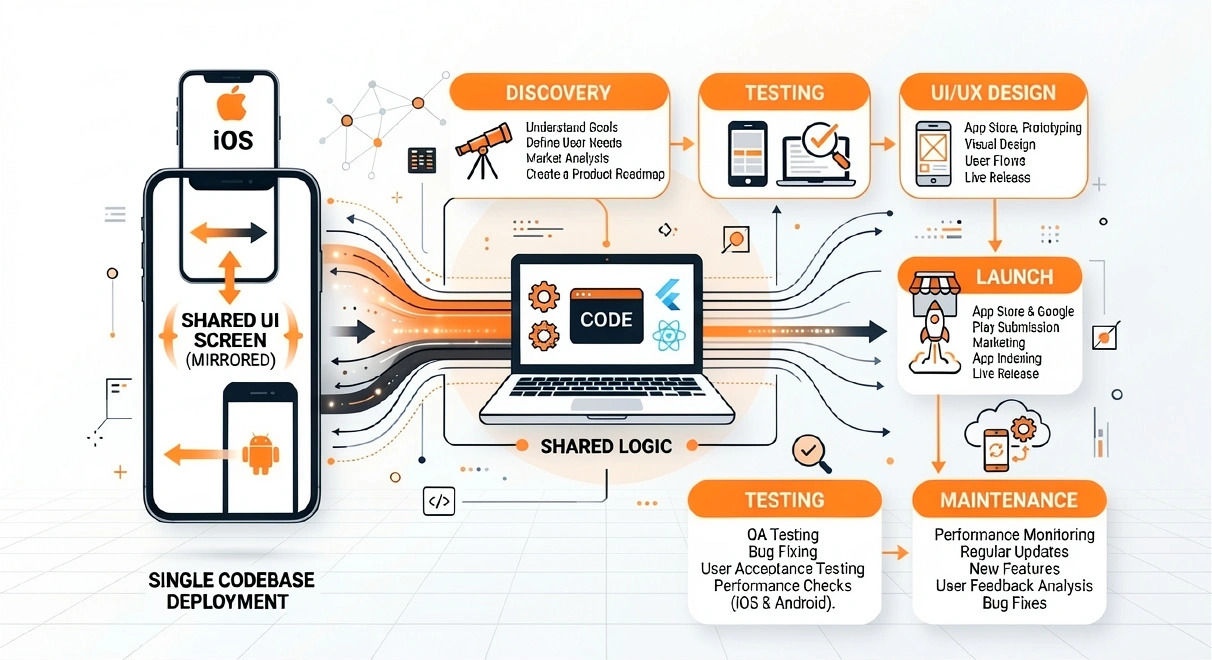
Here is a simplified version of how a professional development team approaches a cross-platform project:
- Discovery and scoping: Define requirements, user flows, and technical constraints.
- UI and UX design: Create wireframes and high-fidelity mockups. Agree on the design system.
- Framework selection: Choose Flutter, React Native, or another option based on team expertise and product needs.
- Development sprints: Build in two-week cycles with regular demos and reviews.
- QA and testing: Test on real devices across both platforms. Cover edge cases, performance, and accessibility.
- App store submission: Prepare assets, descriptions, and comply with platform guidelines.
- Launch and monitoring: Track performance, crashes, and user behavior using tools like Firebase or Sentry.
- Ongoing maintenance: Schedule updates around iOS and Android OS releases.
Frequently Asked Questions
Is cross-platform better than native app development?
For most apps, yes. It offers similar user experience at lower cost. Native is better for advanced performance and deep hardware features.
Which cross-platform framework is best in 2026?
Flutter leads in performance and UI. React Native is best for JavaScript teams. The right choice depends on your project needs.
Is Flutter better than React Native?
Flutter is better for UI performance and consistency. React Native is easier to adopt and has a larger talent pool.
Are hybrid apps good for startups?
Yes, for simple or internal apps. For customer-facing products, cross-platform is a better choice.
How long does cross-platform app development take?
Simple apps: 2–3 months
Medium apps: 4–6 months
Complex apps: 8–12 months
Can cross-platform apps access device features like camera or GPS?
Yes. Most features are supported via plugins. Some advanced features may require native code.
Conclusion
Cross-platform and hybrid app development is no longer a compromise. In 2026, frameworks like Flutter and React Native have matured to the point where the vast majority of apps can be built well on a shared codebase without sacrificing quality or user experience.
The smarter question is not whether to go cross-platform. It is which framework fits your team, your timeline, and your product requirements.
If you are early in your decision, start with the comparison guides linked throughout this page. They will help you get specific before you commit to a direction.
If you are looking for a team that has delivered cross-platform apps across multiple industries, Virtuenetz specializes in Flutter and React Native development for startups and growing businesses.
 ?>
?>
 ?>
?>
 ?>
?>
 ?>
?>
 ?>
?>