
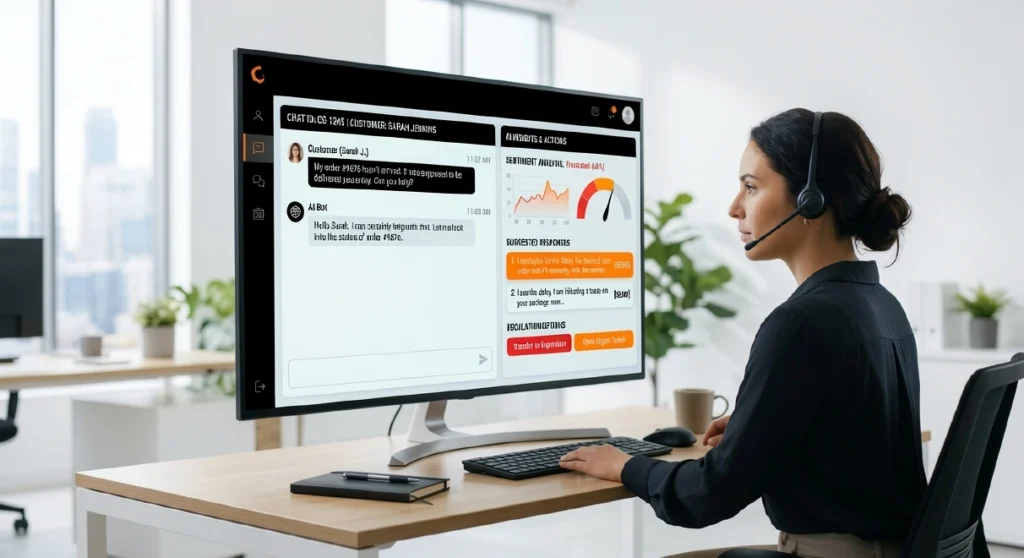
AI-powered customer service has moved from pilot projects to the front line of enterprise operations. Yet as deployments scale in 2026, four foundational challenges continue to erode customer trust, inflate costs, and create compliance risks: a perceived lack of human touch, data bias embedded in training sets, chronic query-misunderstanding, and messy integration with legacy systems.
This report dissects each challenge in depth with documented real-world failures, expert commentary, and a step-by-step solution playbook before looking ahead to where AI support is heading by 2028.
| Challenge | Core Solution |
| Lack of Human Touch | Empathy-first design + escalation protocols |
| Data Bias | Diverse datasets + continuous bias auditing |
| Misunderstanding Queries | Context-aware NLU + feedback loops |
| Integration Issues | API-first middleware + phased rollout |
Lack of Human Touch
Understanding the Challenge
Despite significant advances in large-language-model tone-tuning, customers consistently report feeling “processed rather than helped” when interacting with AI agents. A 2025 Gartner survey found that 68 % of consumers who abandoned a brand after a support interaction cited “robot-like responses” as the primary reason up from 52 % in 2022.
The gap is not merely cosmetic. When customers are distressed dealing with a lost parcel, a billing dispute, or a medical question they need acknowledgment before they need a solution. Current AI systems optimized for resolution speed routinely skip the acknowledgment step entirely.
Real-World Failure: Telco Giant’s “Efficient” Bot
| Case Study — TelcoX Chatbot Backlash (2024)TelcoX deployed a GPT-4-based support bot targeting a 90-second average handle time. Within 60 days, CSAT dropped from 78 to 51. Post-incident analysis revealed the bot was jumping to resolution steps within two turns, never once reflecting the customer’s frustration back to them. A viral Twitter thread titled “Talking to a wall with a keyboard” attracted 200k impressions before TelcoX pulled the bot for re-training. |
Expert Insight
| “Emotional mirroring is not a luxury feature; it is a functional prerequisite for trust. A system that resolves a complaint in 45 seconds but never validates the customer’s frustration will register as dismissive, regardless of its technical accuracy.” |
Solutions
Empathy-First Conversation Design
Redesign dialogue flows so the first response always acknowledges the customer’s stated or implied emotional state before moving to resolution. Use sentiment-classification models (e.g., fine-tuned RoBERTa) to detect frustration, urgency, or confusion in real time and dynamically adjust tone.
- Train on labelled empathetic conversation datasets (e.g., EmpatheticDialogues, BlendedSkillTalk).
- Include explicit acknowledgment templates: “I can see why that would be frustrating, let me sort this out right now.”
- A/B test empathetic vs. efficiency-first openers; measure CSAT delta, not just handle time.
Graceful Human Escalation Protocols
Define trigger conditions that automatically route to a human agent: repeated rephrasing of the same intent, negative-sentiment score above threshold, account VIP flag, or regulatory topic detection (healthcare, legal, finance).
- Warm-transfer context: pass the full conversation transcript and inferred emotional state to the human agent so the customer never has to repeat themselves.
- Set explicit SLAs for escalation wait times. “A specialist will be with you in under 3 minutes” beats an indeterminate queue.
Humanized Persona & Voice
Give the AI a consistent name, personality guardrails, and a conversational cadence calibrated to your brand voice. Avoid overly formal or overly casual defaults both alienate segments of your customer base.
| Fix: TelcoX RebuildAfter the backlash, TelcoX introduced a three-turn empathy buffer before any resolution step, added frustration-score escalation triggers, and re-branded the bot with a human name and bio. Within 90 days CSAT recovered to 81 — three points above the pre-bot baseline. |
Data Bias in AI Customer Service
Understanding the Challenge
AI models inherit the biases present in their training data. In a customer-service context this manifests as differential response quality across demographic groups, language registers, and geographic dialects a problem that carries both reputational and legal risk under the EU AI Act (2024) and equivalent frameworks now active in several US states.
Bias is also dynamic: a model deployed without ongoing monitoring will drift as customer language evolves, new product lines introduce unfamiliar vocabulary, and demographic mix shifts seasonally.
Real-World Failure: FinTech Lending Bot
| Case Study — LoanPal AI Disparate Outcomes (2025)A US FinTech’s AI support agent was found to provide materially less detailed loan-repayment guidance to users who wrote in African-American Vernacular English (AAVE). Internal audit triggered by a compliance whistleblower revealed the training corpus was 94 % Standard American English. The company faced a $4.2 M regulatory settlement and a mandatory third-party bias audit. |
Expert Insight
| “Representative training data is not a nice-to-have — it is the baseline condition for a system that does not discriminate. Every deployment team should ask: whose language, whose problems, whose resolution patterns are overrepresented in this corpus?” |
Solutions
Diverse & Representative Training Data
- Audit training corpora for demographic representation across age, geography, language register, and disability status.
- Actively collect and label conversations from under-represented groups, this may require paid linguistic consultants or community partnerships.
- Use synthetic data generation (paraphrasing, back-translation) to augment scarce categories, but validate synthetic samples with native speakers.
Continuous Bias Monitoring
Bias is not a one-time pre-launch checklist item, it is a continuous operational concern. Implement automated fairness metrics in your MLOps pipeline.
- Track response quality parity metrics (e.g., resolution rate, escalation rate, CSAT) disaggregated by detected language register, region, and channel.
- Schedule quarterly third-party bias audits with mandated remediation SLAs.
- Maintain a bias incident register documented issues drive faster organisational learning.
Inclusive Feedback Loops
Post-interaction surveys and thumbs-up/down signals provide real-time ground truth. Ensure survey instrumentation itself is available in all supported languages and at appropriate reading levels.
| Fix: LoanPal RemediationFollowing the settlement, LoanPal rebuilt its training corpus using a stratified sampling framework ensuring ≥15 % AAVE and ≥20 % non-US English representation. Quarterly bias reports are now published on their investor relations page. Disparate-outcome gap closed to within statistical noise within two model generations. |
Misunderstanding Customer Queries
Understanding the Challenge
Natural language is ambiguous by design. Customers abbreviate, use slang, misspell, switch languages mid-sentence, and assume contextual knowledge the model may not possess. When an AI misinterprets intent asking for a “refund” and being served a “returns policy” FAQ the interaction does not just stall; it actively antagonises the customer.
Misunderstanding has downstream costs beyond CSAT: incorrectly handled queries generate re-contacts that inflate cost-per-ticket, and misdirected escalations waste human-agent time.
Real-World Failure: Airline Self-Service Portal
| Case Study — AirEuro Intent Failure (2024)AirEuro’s AI service portal misclassified “I need to cancel my bag” (meaning remove an add-on bag from a booking) as “cancel flight” in 23 % of sessions. 8,400 customers had flights erroneously staged for cancellation before the model flagged an anomaly in cancellation volume. Emergency rollback cost €1.1 M in agent overtime and goodwill credits. |
Expert Insight
| Sebastian Ruder, Research Lead, Cohere“Intent disambiguation requires more than a good classifier — it requires the system to know when it is uncertain and to ask a targeted clarifying question rather than guessing. Confidence-thresholded clarification is not a fallback; it should be a core design primitive.” |
Solutions
Context-Aware Natural Language Understanding
- Deploy session-level context windows: the current turn should be interpreted in light of the last 3–5 turns, the customer’s product history, and the detected topic cluster.
- Implement entity-linking to your product/service ontology so ambiguous terms (“bag”, “plan”, “card”) resolve to the correct domain object based on account context.
- Use transformer models fine-tuned on your specific domain vocabulary generic models underperform on product-specific jargon.
Confidence-Threshold Clarification
Define intent-confidence thresholds (e.g., below 0.75) below which the model proactively seeks clarification with a concise, targeted question rather than proceeding on the most likely interpretation.
- Ask one clarifying question at a time stacking multiple disambiguation questions in a single turn increases abandonment.
- Offer guided choices where possible: “Do you want to (a) remove a bag add-on, or (b) cancel your entire flight?”
Continuous Intent Feedback Loops
Mine post-interaction survey free text and agent-review notes for patterns of misclassification. Build a misclassification log and retrain on corrected examples quarterly.
- Tag every human-escalated session with the original intent and corrected intent this is gold-standard training data.
- Implement active learning: surface low-confidence sessions for human review rather than waiting for customer complaints.
| Fix: AirEuro RebuildAirEuro introduced entity disambiguation logic that cross-referenced intent with current booking state — if a customer had no active booking, “cancel” would never trigger flight-cancellation. Confidence thresholds were set at 0.80 for any destructive action, requiring explicit confirmation. Similar misclassification incidents dropped to zero in subsequent quarters. |
Integration Issues
Understanding the Challenge
The promise of AI customer service is a 360-degree customer view enabling personalized, contextual support. That promise collapses when the AI cannot reliably read from and write to CRM, OMS, billing, and ticketing systems.
Integration failures broken API calls, schema mismatches, stale data caches are the leading cause of AI support escalations in enterprise environments.
For a broader perspective on how AI fits into enterprise architecture, see Artificial Intelligence in Business, and for data-layer specifics refer to AI Chatbot Data Insights for Business.
Real-World Failure: Retailer Omnichannel Meltdown
| Case Study — RetailCo Black Friday Integration Failure (2024)RetailCo launched an AI agent two weeks before Black Friday. The agent’s OMS integration used a 15-minute cache for inventory data. During peak traffic, the AI promised same-day delivery on items that had sold out—confirming over 14,000 orders for unavailable stock. Manual cancellation emails, refunds, and reputational damage cost the company an estimated $8 M. |
Expert Insight
| “AI agents touching transactional systems need the same observability standards as any production microservice — distributed tracing, alerting on latency spikes, and circuit breakers. Treating the AI as a UI layer and the integrations as an afterthought is a recipe for expensive incidents.” |
Solutions
API-First Integration Architecture
- Design the AI agent as an API consumer, not a direct database client; all data access flows through versioned, contract-tested APIs with clear ownership.
- Implement real-time webhooks or event-streaming (e.g., Kafka) for inventory, order status, and account changes rather than polling or caching.
- Use an integration middleware layer (e.g., MuleSoft, Boomi) to abstract legacy system quirks and provide a unified data model to the AI.
Phased Rollout & Shadow Mode
Never deploy an AI agent with live write access to critical systems without a shadow-mode validation period. In shadow mode, the AI generates actions but humans review and execute them, enabling defect detection without customer impact.
- Shadow mode (4–8 weeks): AI decides, humans execute, discrepancies logged.
- Supervised mode (4–8 weeks): AI executes low-risk actions autonomously; high-risk actions require human approval.
- Full autonomy: AI executes within defined risk parameters with automatic circuit-breakers.
Observability & Circuit Breakers
- Instrument every downstream API call with distributed tracing latency spikes often precede data-consistency failures.
- Implement circuit breakers: if an integration endpoint returns errors above a threshold, the AI should surface a graceful fallback message and escalate rather than proceeding on stale or missing data.
- Set up real-time alerts for anomalous action patterns (e.g., cancellation volume 3× baseline) with automated holds pending human review.
| Fix: RetailCo RebuildRetailCo switched to event-driven inventory updates with a maximum staleness of 30 seconds. They introduced an inventory-hold step before any delivery commitment, and added a circuit breaker that paused delivery promises if OMS latency exceeded 2 seconds. The following Black Friday processed 3× the volume with zero over-committed inventory incidents. |
The Future of AI Customer Support
Despite today’s challenges, the trajectory of AI customer service is unmistakably positive. Four developments are converging to reshape the landscape by 2028.
Multimodal Support Agents
Next-generation agents will process voice, image, video, and text in a single session. A customer struggling with a hardware product will be able to show their screen or device to the AI, which will diagnose the issue visually eliminating the frustrating describe-the-problem-in-words loop.
Agentic Workflows & Autonomous Resolution
Agentic AI frameworks (LLM + tool-use + memory) will allow support bots to autonomously navigate multi-step processes: processing a return, issuing a refund, scheduling a technician, and sending a confirmation all in a single interaction without any human handoff for routine cases.
Hyper-Personalization via Customer Memory
Persistent memory layers will allow AI agents to recall past interactions, preferences, and pain points, enabling a continuity of relationship that today requires a dedicated account manager. This will be particularly transformative in B2B support contexts.
Regulatory Maturity & Explainability Standards
As the EU AI Act and equivalent frameworks mature, explainability the ability to show why the AI took a particular action or made a particular recommendation will shift from a compliance checkbox to a core product feature, raising the bar for transparency across the industry.
Frequently Asked Questions
Q: Is AI customer service cheaper than human agents?
A: In the short term, implementation costs (integration, training, QA) often exceed savings. At scale typically above 10,000 monthly interactions. AI materially reduces cost-per-ticket, but the saving is maximized only when human escalation rates are kept low through good design.
Q: How do I know if my AI agent is biased?
A: Run disaggregated performance analysis: break your resolution rate, CSAT, and escalation rate down by customer segment, language, geography, and channel. Statistically significant differences between segments are a bias signal. Engage a third-party auditor annually at minimum.
Q: What is the right escalation rate for an AI support system?
A: Industry benchmarks vary by sector, but a well-designed AI should handle 65–80 % of contacts autonomously in mature deployments. Escalation rates persistently above 40 % suggest intent-understanding or integration problems worth investigating.
Q: How long does it take to integrate AI with a legacy CRM?
A: A read-only integration typically takes 6–12 weeks. Full bi-directional integration with write-back and real-time data requires 4–9 months depending on CRM vintage and API maturity.
Q: Can AI handle emotionally sensitive customer service situations?
A: Current AI handles mild-to-moderate frustration reasonably well with proper empathy design. For high-distress situations. best practice is to detect these contexts early and escalate to a human immediately.
Q: What metrics should I track for AI customer service performance?
A: Core metrics: Containment Rate (% fully resolved by AI), CSAT/CES, First-Contact Resolution, Average Handle Time, Escalation Rate, Cost-per-Contact, and Bias Parity Score.
Conclusion
The four challenges documented here empathy deficit, data bias, query misunderstanding, and integration fragility are not abstract engineering concerns. Each has produced documented, costly, and reputationally damaging failures at real companies in the past 24 months.
The good news is that every challenge has a well-understood solution path. The companies winning in AI customer service in 2026 share a common discipline: they treat their AI deployment as a living product that requires continuous measurement, bias auditing, and iterative retraining not a one-time IT project.
Organizations that invest in empathy-first design, representative data, context-aware NLU, and API-grade integration architecture today will be positioned to unlock the genuinely transformative capabilities multimodal agents, agentic workflows, and persistent memory that are arriving in the near term.