

Warehouse Management System in Saudi Arabia
A warehouse management system (WMS) in Saudi Arabia is software that runs the work inside your warehouse: receiving goods, giving each item a bin location, guiding pickers, packing orders and counting stock. VirtueNetz builds custom WMS software for Saudi businesses, in Arabic and English, connected to your ERP, ZATCA e-invoicing and delivery partners.
Still chasing stock through spreadsheets, WhatsApp groups and a clipboard at the dock? A good WMS ends the guessing. Every pallet, carton and pick gets scanned, so you always know what you have, where it sits and what is ready to ship.
VirtueNetz KSA is based in Jeddah and builds warehouse management systems for operations teams across the Kingdom. Tell us how your warehouse runs today, and we’ll tell you honestly what to fix first.
Register Your Interest
Built around your floor
We walk your warehouse first: your zones, your pick routes, your paperwork. No generic template.
Connects to what you already run
ERP, accounting, ZATCA e-invoicing, online stores and delivery partners, linked through APIs.
Made for handheld scanners
Operators scan on Android handhelds in Arabic or English, and the app is designed to keep working when the Wi-Fi drops.
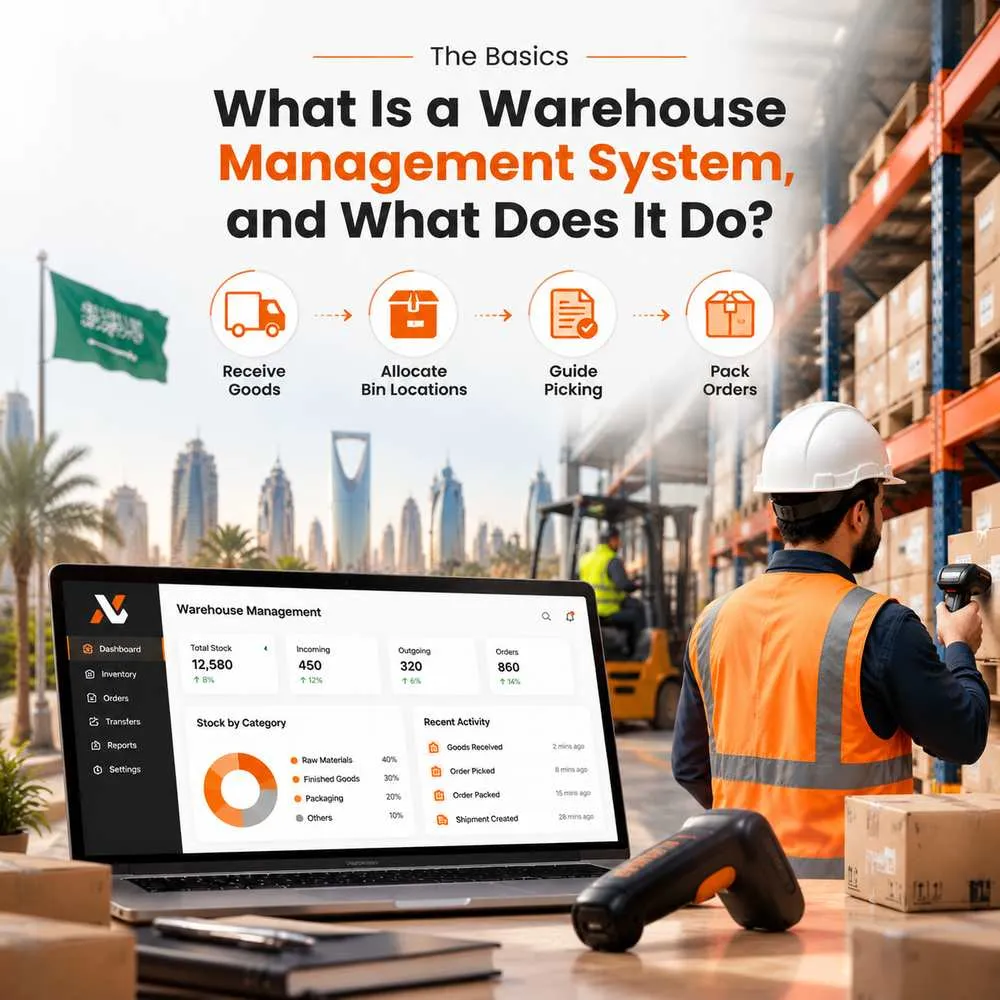
// The Basics
What Is a Warehouse Management System, and What Does It Do?
A warehouse management system is software that controls the daily flow of goods inside a warehouse. It tells staff where to put stock when it arrives, which items to pick for each order, and what is left on every shelf. Unlike a basic inventory list, it works at bin-location level and updates in real time as people scan.
In a Saudi warehouse that also means Arabic and English screens, ZATCA-compliant invoices once goods ship, a mix of fast and slow movers, and sharp peaks around Ramadan, Eid and sales events. Example: a Riyadh distributor receives a truckload of pallets overnight. With a WMS, a handheld tells the team exactly which bin each pallet goes to, and the stock is available to sales the moment it is put away.
WMS, ERP Inventory and TMS: What Is the Difference?
People mix these up, so here is the short version. Need the delivery side? See our transport management system.
| WMS | Runs what happens inside the four walls: receiving, putaway, picking, packing and counting |
|---|---|
| ERP Inventory Module | Tracks stock quantity and value for finance and sales, usually per warehouse, not per bin |
| TMS | Plans and tracks transport once goods leave: trucks, routes and drivers |
| All Three Together | Orders flow from ERP to WMS to TMS and back, with nobody retyping anything |
Signs You've Outgrown Spreadsheets
If three or more of these sound familiar, a warehouse management system will probably pay for itself.
- Physical counts never match what the system says
- Pickers walk back and forth because nobody knows where items are
- Orders ship late, or the wrong item goes out
- You find expiry dates by accident
- Two or three people hold the whole warehouse in their heads
- New staff take weeks to learn where things live
Features
Warehouse Management Software Features Saudi Businesses Ask For
These are the features we get asked about most in warehouse and inventory management software. You don’t need all nine on day one, and we’ll help you decide which come first.
Receiving and Putaway
Scan goods in against the purchase order, flag shortages, and send each item to the best bin.
Bin Location Management
Every shelf, rack and zone has a code, so any item can be found in seconds.
Picking and Packing
Guided wave, batch or zone picking, with a packing check before the box is sealed.
Barcode and RFID Tracking
Barcode scanning as standard, RFID and sensors where the goods and the budget justify them.
Cycle Counting
Count a few locations every day instead of closing the warehouse once a year for a stock take.
Batch, Expiry and Serial Tracking
First-expired-first-out picking and full traceability for food, pharma and spare parts.
Multi-Warehouse Inventory Management
One view across Riyadh, Jeddah, Dammam and beyond, with transfers tracked end to end.
Returns Management
Multi-Warehouse Inventory Management
Reports and Smart Insights
Live dashboards, plus demand and slotting suggestions where your data supports them.
Warehouse KPIs a Good WMS Should Report
If your system can’t show these, you’re flying blind. We agree the targets with you before the build starts.
| Inventory Accuracy | How closely the system count matches what is physically on the shelf |
|---|---|
| Order Accuracy | The share of orders shipped with the right items, in the right quantity |
| Dock-to-Stock Time | How long goods take from the truck door to being available for sale |
| Order Cycle Time | The time from an order being released to it being ready to ship |
| Pick Rate per Labour Hour | How many lines or units each picker handles per hour |
| Space Utilisation | How much of your storage space is actually in use |
Build or Buy
Custom Warehouse Management System Development vs Off-the-Shelf WMS Software
When you compare WMS software in Saudi Arabia, be honest about your size. If you run one small warehouse with standard processes, a ready-made WMS or your ERP’s warehouse module may be all you need, and we’ll say so. Custom starts to win when your way of working is the thing that makes you competitive. Read more about our custom software development.
Custom WMS
- Screens and rules copy how your floor really works
- Connects to your ERP, couriers and stores exactly the way you need
- Add sites, zones and features without renegotiating licences
- Higher upfront cost, lower friction as you grow
Off-the-shelf WMS or ERP module
- Quick to start, but you adapt your process to the tool
- Per-user and per-site fees often climb as you grow
- Unusual workflows mean workarounds or paid customisation
- Arabic labels and local reports may need extra work
Industries
Who Needs a Warehouse Management System in Saudi Arabia?
Anyone who stores stock for other people to buy, make or use. These are the businesses we hear from most when they ask for a warehouse management system in Saudi Arabia.
3PL and Fulfilment Providers
E-Commerce and Retail
FMCG and Distribution
Pharma and Healthcare Supply
Manufacturing and Spare Parts
Construction Materials
Food and Beverage
Automotive Parts
Integration
WMS Integration With ERP, ZATCA E-Invoicing and Delivery Partners
Your warehouse doesn’t work alone, so the WMS shouldn’t either. We connect it to the systems around it, where each system gives us access.
| ERP and Sales Orders | Orders, purchase orders and stock levels stay in sync, so sales never sells what isn't there. See our ERP software for distribution |
|---|---|
| ZATCA E-Invoicing | Shipped orders feed compliant invoices with QR codes and e-invoice reporting. See our accounting software |
| Transport and Couriers | Dispatch lists, delivery status and proof of delivery flow back into the warehouse record |
| Online Stores | Stock levels update on your website or marketplace as soon as an item is picked or received |
| Scanners and Printers | Android handhelds, barcode label printers and weighing scales |
| Cloud Platform | Multi-site access with role-based permissions. See how we build SaaS platforms |
Saudi Logistics
Warehouse Management System Riyadh, Jeddah and Dammam: Built for Saudi Logistics
Saudi Arabia is building its logistics backbone fast. The Master Logistics Centers Plan outlines 59 centres covering more than 100 million square metres, with 21 under development and completion targeted for 2030. The national strategy also aims to lift the Kingdom into the top 10 of the World Bank's Logistics Performance Index by then. More centres mean more stock, more sites and more pressure on accuracy. The market is already moving: the first WMS inside a Riyadh Special Integrated Logistics Zone facility went live at an e-commerce fulfilment centre. Smaller Saudi operators face the same pressure, and they need systems that fit their size and budget.
Riyadh
Distribution centres, logistics zones and e-commerce fulfilment. See our software development in Riyadh.
Jeddah
Our home city and the Red Sea gateway for imports. See our software development in Jeddah.
Dammam and the Eastern Province
Port-linked distribution and industrial supply chains.
Jubail and Yanbu
Industrial spare parts, materials and project stock.
Makkah and Madinah
Seasonal spikes in hospitality, food and retail supply.
Remote Across Saudi Arabia
Video workshops in Arabic and English, with on-site visits when needed.
Mobile
Handheld Scanner and Mobile Apps for Your Warehouse Team
Warehouse staff don’t sit at desks, so the app has to work in their hands. We build the operator app for Android handhelds and phones. See our Android app development and Flutter app development.
Scan-First Screens
Big buttons, few taps and clear next-step prompts for gloved hands.
Built for Weak Wi-Fi
Designed to keep working in dead spots and sync when the signal returns.
Arabic and English
Operators choose their language, and labels print in both.
Photo Proof
Capture damage on arrival or proof of dispatch right from the handheld.
How Much Does a Warehouse Management System Cost in Saudi Arabia?
Whether you ask about WMS pricing or the total cost of a warehouse management system in Saudi Arabia, it depends on the size of your operation, and we won't guess a number before we have seen your warehouse. A single site with standard flows costs far less than several sites with RFID, integrations and custom rules. After discovery you get a written scope and fixed price. These are the factors that move the number:
- Number of warehouses, zones and users
- How complex your processes are: picking methods, returns, kitting, batches
- Integrations with ERP, ZATCA e-invoicing, couriers and online stores
- Hardware: handhelds, label printers and RFID, quoted separately
- Data migration and the opening stock count
- Arabic and English labels, documents and reports
- Hosting, data residency and security needs
- Training and ongoing support
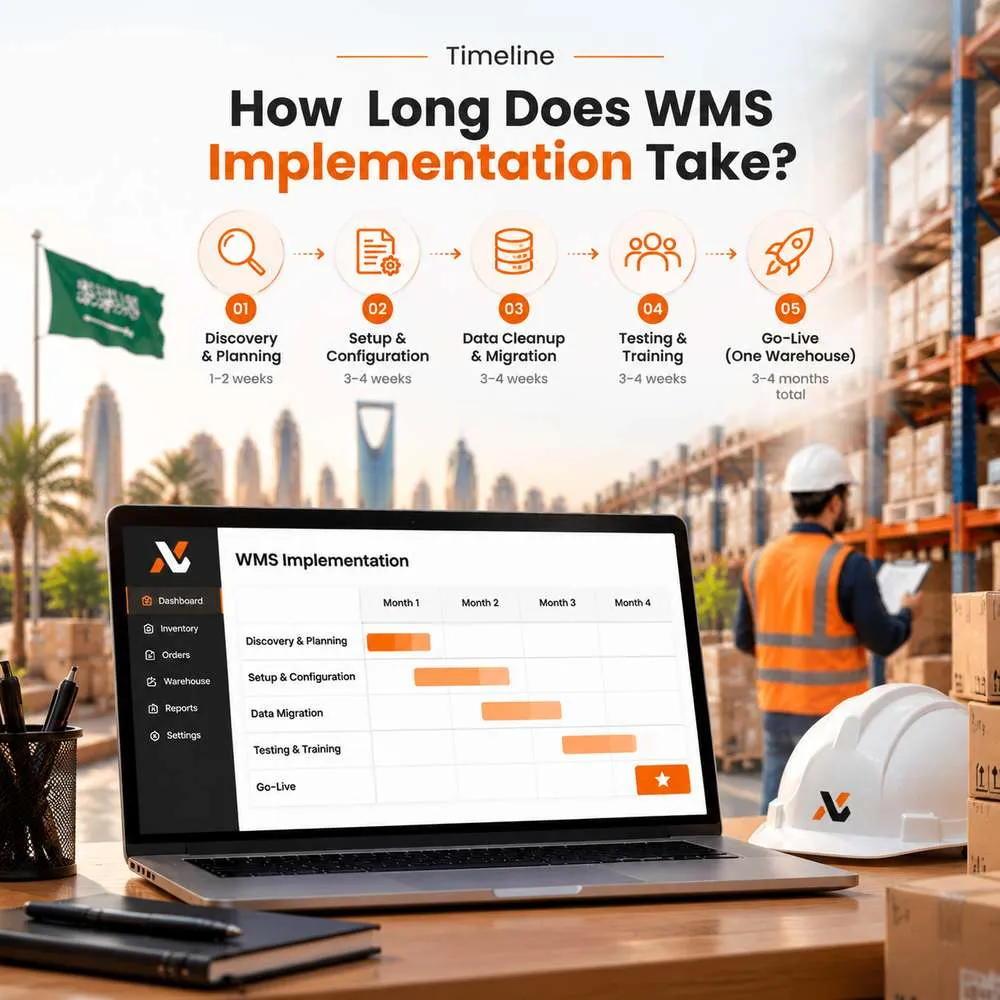
// Timeline
How Long Does WMS Implementation Take?
A focused WMS implementation in Saudi Arabia for a single warehouse commonly takes around three to four months from discovery to go-live. Several sites, many integrations or RFID usually take longer. You get a written timeline after discovery, not a generic range.
What stretches a project most is rarely the software. It is messy stock data, unclear location codes, late access to the ERP, and the warehouse team having no time to test. We go live zone by zone and run the old and new methods side by side for a short period, so the warehouse never stops.
Our Process
Our Warehouse Management System Implementation Process
Six steps, and we agree on each one with you before the next begins.
Warehouse Walk and Process Mapping
We follow goods from the dock to the shipping door and write down how it really works today.
Build and Integrate
Built in sprints with weekly demos, then connected to your ERP, couriers and stores.
Data Migration and Stock Count
We load your items and locations, run an opening count and go live one zone at a time.
Design
We define locations, picking rules, scanning flows and reports, and show a prototype your team can try.
Test on the Floor
Real scanners and printers, busy-hour order volumes and weak Wi-Fi spots, not just a demo room.
Go-Live Support
We stay close through the first busy weeks to fix what real use reveals.
Trust
WMS Data Security, Access Control and PDPL
A warehouse system holds stock values, customer orders and staff activity. We limit who can see and change what, log every movement and plan where the data is hosted. Staff and driver details are personal data, so we design with Saudi PDPL in mind.
We do not claim certification or guaranteed compliance on your behalf. PDPL obligations depend on how your company collects and uses data, so involve your legal adviser or data protection officer early.
Role-Based Access
A storekeeper, a supervisor and a finance manager each see only what they need.
Full Audit Trail
Every receipt, move, pick and adjustment shows who did it and when.
Data Residency Planning
We decide where data is stored before we build.
Backups and Recovery
Regular backups and a tested recovery plan, so a bad day doesn’t stop the warehouse.
// Why VirtueNetz
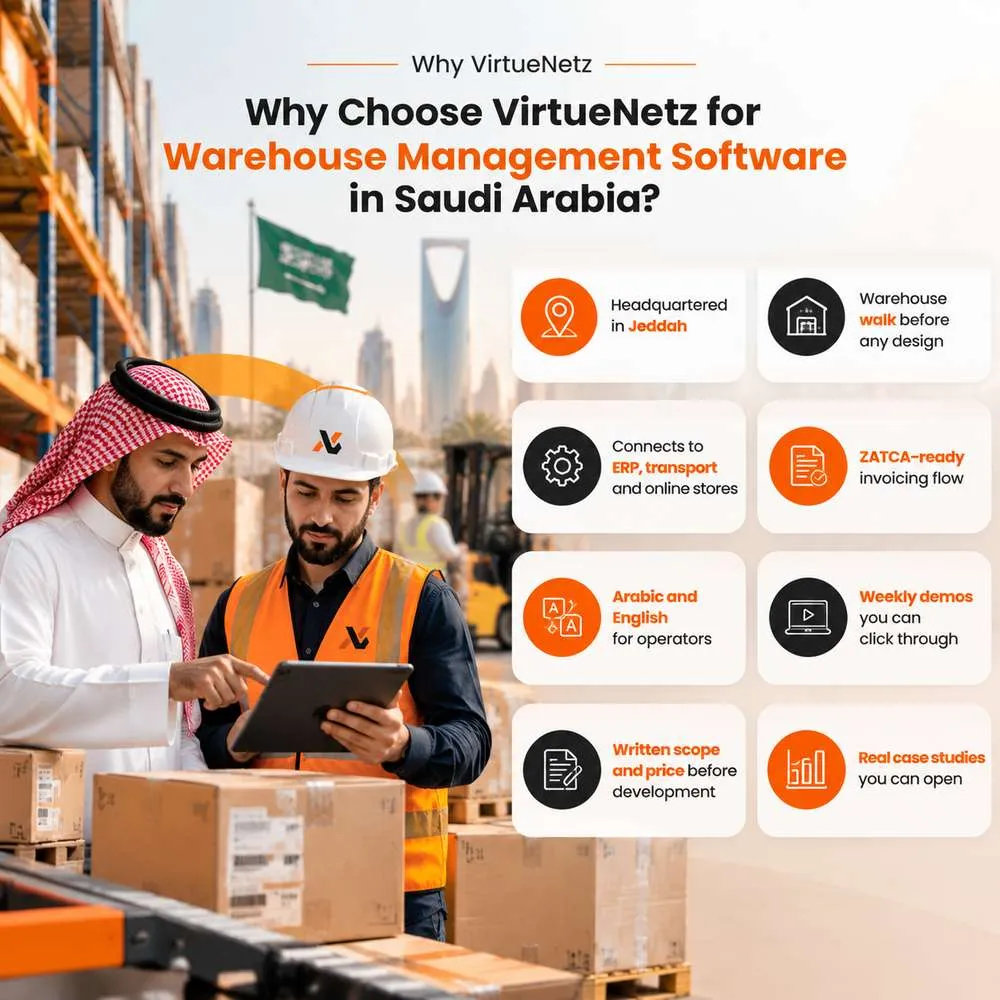
Why Choose VirtueNetz for Warehouse Management Software in Saudi Arabia?
We start on your warehouse floor, not in a spreadsheet. We’re a Jeddah-based team building warehouse management systems for Saudi Arabia, we work in Arabic and English, and we’d rather tell you that your ERP’s module is enough than sell you a system you don’t need.
- Headquartered in Jeddah
- Warehouse walk before any design
- Connects to ERP, transport and online stores
- ZATCA-ready invoicing flow
- Arabic and English for operators
- Weekly demos you can click through
- Written scope and price before development
- Real case studies you can open
// Proof
Logistics and Operations Systems We've Built
We haven't published a warehouse management case study yet, so here are the closest examples of our logistics and operations engineering. LoadMate was delivered for a client in the UAE. Want more? Browse the full portfolio.

LoadMate
A logistics & truck-booking mobile app — streamlining freight management by connecting drivers and clients through one digital platform with…
Order & Delivery Platform
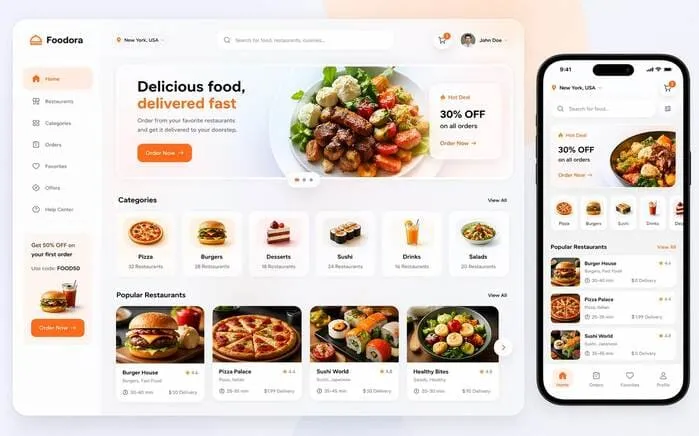
A multi-role food ordering & delivery marketplace — connecting home chefs, customers, and delivery partners through real-time tracking, secure payments,…

Talent & Resource Portal
A centralized talent marketplace — connecting students, government departments, and organizations for opportunities, internships, and training, powered by secure identity…
Quick Answers
Frequently Asked Questions About Warehouse Management Systems in Saudi Arabia
A warehouse management system is software that controls what happens inside a warehouse: receiving goods, assigning bin locations, guiding picking and packing, and counting stock. It updates in real time as staff scan items, so you always know what you have and where it is.
The cost depends on the number of warehouses, users and processes, the integrations you need, hardware such as handheld scanners and printers, data migration and Arabic and English requirements. VirtueNetz gives a written scope and fixed price after discovery. Request a quote and we tailor it to your warehouse.
A focused WMS for a single warehouse commonly takes around three to four months from discovery to go-live. Several sites, many integrations or RFID usually take longer. You get a written timeline after discovery, and we go live zone by zone so operations never stop.
ERP inventory tracks stock quantity and value for finance and sales, usually per warehouse. A WMS works inside the warehouse at bin-location level, guiding receiving, putaway, picking and packing with scans. Many Saudi businesses use both, with the ERP sending orders to the WMS and the WMS sending stock updates back.
Not always. With one small warehouse, few SKUs and simple flows, your ERP’s inventory module or a ready-made tool may be enough. A WMS pays off when stock counts drift, pickers waste time searching, orders ship wrong, or you manage several sites. We tell you honestly which side you are on.
Yes. The WMS can pass shipped orders to your accounting or invoicing system, which issues ZATCA-compliant e-invoices with QR codes and handles reporting. The exact flow depends on your accounting setup and ZATCA accounts, so we confirm it in discovery. Check your own obligations with ZATCA or your accountant.
Yes. Screens, labels, documents and reports work in Arabic and English, and operators can choose their language on the handheld. We test both languages with your real item names and printed labels, not only the interface.
Yes. We build the operator app for Android handhelds and phones. It is designed to keep working in weak Wi-Fi spots and sync when the connection returns. The exact offline behaviour depends on your workflows, and we test it on your warehouse floor before go-live.
Off-the-shelf software is a sensible choice for one warehouse with standard processes. A custom WMS pays off when your workflows are unusual, you need tight links to your ERP, couriers and stores, or per-user licence fees would climb as you grow. We tell you honestly which fits.
Yes. A cloud-based WMS gives you one view of stock across every site, with transfers tracked between warehouses. Site managers can be limited to their own location while head office sees everything. Role-based access keeps the data separated where you need it.
Start with barcodes. They are cheap, reliable and enough for most warehouses. RFID makes sense for high-value goods, very fast counting or tagged returnable assets, but tags, readers and setup cost more. We usually recommend barcodes first, then RFID in selected zones if the numbers justify it.
Look for a provider that walks your warehouse before designing, shows a working prototype early, explains integrations with your ERP and ZATCA flow, supports Arabic and English, and agrees a written scope and price. Ask for real case studies. VirtueNetz is happy to be compared on every point.
Get Started
Talk to VirtueNetz About Your Warehouse Management System
Tell us about your warehouse: how many sites, how many people, what goes wrong most often and which systems you already use. A senior engineer replies with an honest view on whether you need a custom WMS, what to start with and what it would take.