
AI RAG
01Project Overview
02The Challenge
The answers existed — in a shared drive, a wiki, a folder of PDFs, and several years of closed tickets. Finding them was the problem. The gaps were clear:
- Keyword search returned a list of files, not an answer, leaving people to read through them.
- Staff asked colleagues instead of searching, so a handful of experts became bottlenecks.
- A model on its own had no access to internal knowledge and confidently filled in the blanks.
- Superseded documents sat beside current ones with nothing to distinguish them.
- Some material was restricted, so a single open search index was never an option.
- Nobody could verify where an answer came from, which killed trust in the results.
The opportunity was to make the existing knowledge answerable — and to make every answer checkable.
03Our Approach
Retrieval quality decides whether a RAG system is useful, so that's where the work went:
- Inventoried every source and prioritized the documents people actually ask about.
- Built an ingestion pipeline that parses and chunks with structure intact — headings, tables, and clauses stay whole.
- Combined semantic and keyword search, then reranked, so both meaning and exact terms are covered.
- Required the model to answer only from retrieved passages and cite each one.
- Enforced permissions at retrieval time, so results are filtered to what each user may see.
- Re-index on change and prefer the current version when documents supersede each other.
- Scored retrieval against a real question set and tuned chunking and ranking against the results.
04Key Features
Document Ingestion
Pulls in PDFs, Office files, wiki pages, and tickets, keeping their structure intact.
Hybrid Search
Semantic and keyword retrieval together, reranked so the best passages surface first.
Cited Answers
Each claim links to the document and section it came from, one click from verification.
Permission-Aware
Retrieval is filtered per user, so restricted material never reaches an answer it shouldn't.
Always Current
Sources are re-indexed when they change, and newer versions win over superseded ones.
Retrieval Evaluation
A scored question set measures whether the right passage is being found, release after release.
05How It Works
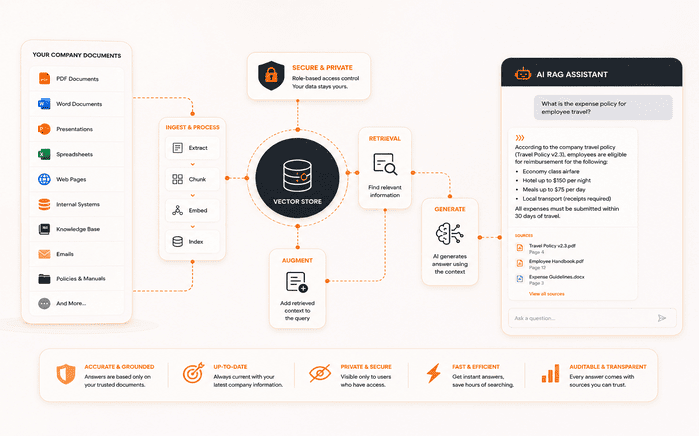
Documents are prepared once and kept fresh. At question time the system retrieves candidate passages, reranks them, and lets the model answer only from what it found.
INGESTION  (runs on change)                QUERY TIME
 ┌──────────────────────────────┐        ┌──────────────────────────────┐
 │ PDFs · Docs · Wiki · Tickets │        │ User question                │
 │            ▼                 │        │            ▼                 │
 │ Parse   keep structure       │        │ Retrieve vector + keyword   │
 │ Chunk   headings, tables     │        │ Filter   user permissions   │
 │ Embed   store vectors        │───────▶│ Rerank   best passages first │
 │ Index   vector + keyword     │        │ Answer   with citations     │
 └──────────────────────────────┘        └──────────────┬───────────────┘
                                                        │
                                    passage found       │      nothing relevant
                                                        ▼
                                          "Not covered in the documents"
— logged as a knowledge gap06Problems Solved
Search that returns documents, not answers
A search for a policy detail returned twelve files, each dozens of pages long, and the reader still had to find the paragraph that mattered.
The system returns the answer in a sentence or two, with the exact source section linked underneath for anyone who wants the full context.
Confident answers nobody could verify
A model without access to internal material produced plausible answers drawn from nothing in particular — the most expensive kind of wrong.
Answers are constructed only from retrieved passages and always cite them. When retrieval finds nothing, the system says the question isn't covered.
Restricted material in a shared index
Some contracts and HR files were open to a few people only, which made a single searchable index across everything impossible to approve.
Permissions are applied during retrieval, so two people asking the same question receive answers drawn only from what each is cleared to see.
07Grounded by Design
Every Claim Has a Source
Answers carry citations, so anyone can check the original before acting on it.
Silence Beats Invention
When the documents don't cover a question, the system says so and logs the gap.
Access Rules Still Apply
The knowledge layer inherits existing permissions rather than quietly working around them.
Measured Retrieval
A scored question set shows whether the right passages are being found, not just whether answers read well.
08Results & Impact
09Conclusion
The AI RAG System shows that the value of retrieval isn't just accuracy — it's accountability. By grounding every answer in the company's own documents, citing the source, respecting who may see what, and admitting when the knowledge simply isn't there, VirtueNetz turned an unsearchable archive into something the team can ask questions of and actually rely on.
10Project Summary
| Project Name | AI RAG System |
| Role | AI Solution Design & Development (Retrieval-Augmented Generation) |
| Industry | Knowledge Management / Enterprise Search |
| Audience | Internal teams, support staff & new joiners |
| Purpose | Turn scattered company documents into cited, permission-aware answers |
| Technology | Python, LangChain, PostgreSQL with pgvector, OpenSearch, embedding & reranker models, FastAPI, React |
| Location | United States |
11Technologies Used
Sitting on knowledge nobody can find?
VirtueNetz builds retrieval systems that answer from your own documents, cite every source, and respect who's allowed to see what. virtuenetz.com · Live to Amaze
Start a Project


Let's Talk About
Your Software or AI Project
Tell us what you're building, and a senior engineer reviews it, not a template reading from a script.