
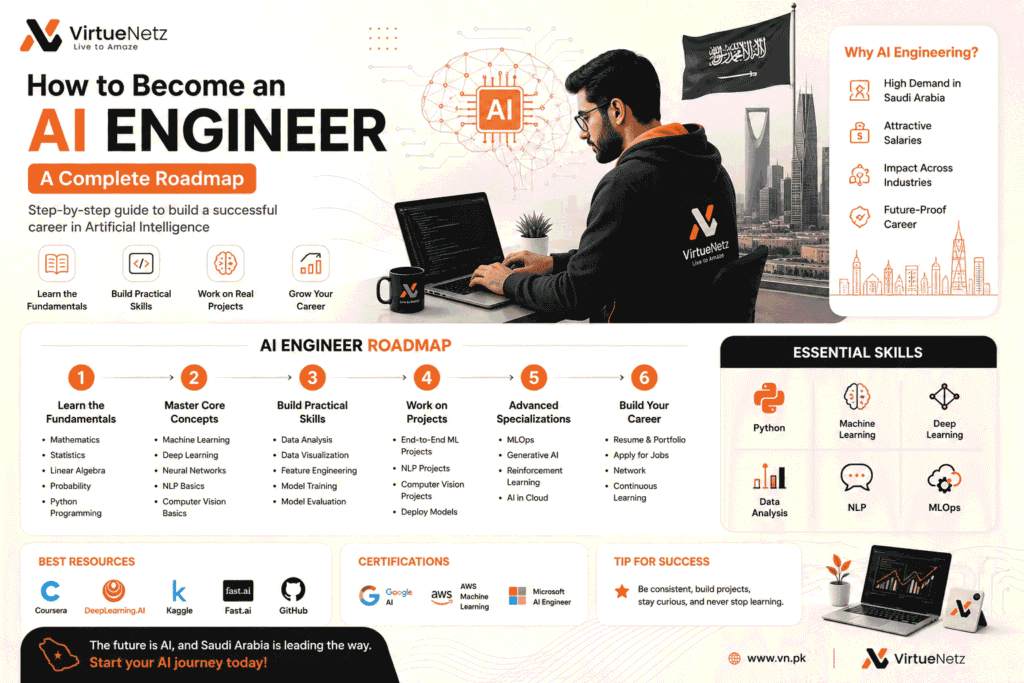
Search “how to become an AI engineer” and you’ll find two extremes. One camp says you need a PhD and five years of research experience. The other says you can do it in a weekend with a prompt engineering course. Neither is honest. The real path sits in between, and it’s more achievable than the first camp claims, and more work than the second one admits.
This is a practical roadmap, the skills that actually matter, the order that makes sense to learn them in, and an honest answer to whether you need a degree at all.
What Does an AI Engineer Do?
An AI engineer builds systems that use machine learning models to do something useful, not just experiment with them in a notebook. That means taking a model, whether it’s one you trained or one you’re calling through an API, and wrapping it in the infrastructure that makes it reliable, fast, and safe to run in a real product. A machine learning engineer and an AI engineer overlap heavily, but AI engineering today leans more toward working with existing foundation models, building applications on top of Large Language Models (LLMs), than training models from scratch.
Day to day, that can mean building a RAG pipeline so a chatbot answers from a company’s actual documents, designing an AI agent that can take multi-step actions instead of just responding to one prompt, or setting up the MLOps pipeline that keeps a model running reliably after it’s deployed.
AI Engineer vs Machine Learning Engineer
These titles get used almost interchangeably, but there’s a real difference worth knowing before you pick a learning path.
| AI Engineer | Machine Learning Engineer | |
|---|---|---|
| Core focus | Building applications on top of existing models, often LLMs | Training and fine-tuning models from data |
| Typical tools | LangChain, vector databases, APIs, RAG | TensorFlow, PyTorch, data pipelines |
| Math depth needed | Moderate, enough to reason about model behavior | Heavier, needed to actually train and tune models |
| Common entry point | Software engineers moving into AI | Data scientists moving into production systems |
Most people starting today are better served learning the AI engineer path first, it’s faster to reach something usable, and a lot of the machine learning fundamentals get picked up along the way anyway.
The Skills You Actually Need
Skip the 40-item skill lists you’ll find elsewhere. Here’s what actually matters, grouped by how deep you need to go.
1. Programming (Non-Negotiable)
Python for AI is the standard, not a suggestion. Nearly every AI library, tutorial, and job posting assumes it. Comfort with Git and GitHub comes right alongside it, since almost every real AI project involves version control and collaborating on code, not working alone in a single script.
2. Math and Statistics (Enough, Not All of It)
Mathematics for AI and statistics for AI scare people off more than they should. You don’t need to derive backpropagation by hand. You need enough linear algebra and probability to understand why a model behaves the way it does, and enough statistics to evaluate whether a result is actually meaningful or just noise.
3. Core Machine Learning and Deep Learning
Machine learning fundamentals, how models learn from data, what overfitting actually means, how to evaluate a model, come before deep learning and neural networks. Frameworks like TensorFlow and PyTorch are how this gets implemented in practice, and most learners settle on one rather than mastering both early on.
4. Specialized AI Domains
Pick a lane before going deep. Natural Language Processing (NLP) covers text and language.Computer vision covers images and video. Most AI engineers today lean toward NLP first, since it overlaps directly with generative AI and LLM-based work, which is where most of the current job demand sits.
5. Modern AI Engineering Tools
This is the layer that’s genuinely new over the last two years, and it’s what separates an AI engineer from someone who only studied classic machine learning. Prompt engineering, working effectively with LLMs through careful instruction design, LangChain for building applications around models, RAG for grounding a model’s answers in real data, vector databases for storing and searching that data efficiently, and building actual AI agents that can plan and execute multi-step tasks.
6. MLOps and Deployment
A model that only works in a notebook isn’t a product. MLOps covers the practical side, deploying a model, monitoring its performance over time, and updating it without breaking whatever depends on it. This is the skill gap that separates people who can build a demo from people who can ship something real.

A Realistic Roadmap: Step by Step
- Learn Python properly first. Not just syntax, actual comfort writing and debugging real programs. Skipping this step to jump straight to AI libraries is the most common mistake.
- Cover the math you actually need. A focused linear algebra and statistics refresher, not a full university course, is usually enough to start.
- Learn core machine learning concepts. How models are trained, evaluated, and where they commonly go wrong.
- Pick a specialization and go deeper. NLP or computer vision, based on what kind of AI work interests you more.
- Learn the modern AI engineering stack. LangChain, RAG, vector databases, and how to build with LLMs directly, this is where most current job postings actually live.
- Build an AI portfolio, not just tutorials. Three real, working projects beat ten half-finished course exercises. A recruiter wants to see something they can actually try.
- Learn just enough MLOps to deploy something. Get one project actually running somewhere real users could reach it, not just on your own laptop.
- Apply for AI internships or junior roles while still learning. Real project experience, even small, teaches things no course does.
A realistic timeline: someone with an existing software background can reach a job-ready level in 6 to 12 months of focused, consistent work. Someone starting from zero programming experience is usually looking at 12 to 18 months. Anyone promising a job-ready AI engineer in 6 weeks is selling a course, not describing reality.
FOR BUSINESSES READING THIS
Hiring and Training an AI Engineer Takes Months. We Already Have Them.
If you’re reading this because your business needs AI built, not because you’re planning a career change, here’s the shortcut: hiring one AI engineer and getting them productive typically takes 3 to 6 months, and that’s before they’ve built anything for you yet. Our team already covers the full stack described above, LLMs, RAG, AI agents, MLOps, and we’re ready to start on your project now, not after a hiring cycle.
AI Development ServicesAI Agent DevelopmentGenerative AI DevelopmentMachine Learning Development
Can You Become an AI Engineer Without a Degree?
Yes, realistically. A computer science degree helps, mainly because it forces the math and fundamentals early, but it isn’t a requirement anymore. What actually gets someone hired without a degree is a working AI portfolio that proves the skills a degree would otherwise vouch for. Companies hiring AI engineers increasingly care more about what you’ve built than what’s on a transcript, especially at AI developer and application-focused roles rather than research positions.
Where a degree still matters more: research-heavy roles, and companies with rigid HR filtering that screens resumes before a human ever sees the portfolio. Outside of those specific cases, the path is genuinely open.
Which Programming Language Is Best for AI Engineering?
Python, without much competition. It has the largest library ecosystem for machine learning and LLM development, the most tutorials and community support, and it’s what almost every AI framework, from TensorFlow to LangChain, is built around. Other languages show up in specific contexts, R in some data science work, C++ where raw performance matters, but for someone starting the path to becoming an AI engineer, the answer isn’t close.
AI Engineer Certifications and Courses Worth Considering
AI engineer certification programs vary widely in quality, and a certificate alone rarely gets someone hired on its own. What they’re genuinely useful for is structure, giving a beginner a clear sequence to follow instead of guessing what to learn next. The strongest ones combine structured lessons with real projects you can point to afterward, not just a quiz at the end of a video series.
Treat a course as the map, not the destination. The projects you build during and after it are what actually go in your portfolio.
What Does an AI Engineer Earn?
AI engineer salary varies significantly by region, company size, and specialization, enough that a single global number isn’t very useful. What’s consistent across markets: AI engineering roles command a real premium over general software development roles at a comparable experience level, and that gap tends to widen for engineers with hands-on LLM and AI agent experience specifically, since that skill set is newer and still in shorter supply than classic machine learning skills.
Building an AI Portfolio That Actually Gets Noticed
A portfolio of three tutorial clones does less for you than one original project solving a real problem. A few ideas that consistently stand out:
- A RAG-based application answering questions from a specific, real dataset, not a generic demo.
- A working AI agent that completes a multi-step task, booking, research, data lookup, rather than a single-turn chatbot.
- A deployed project, not just code on GitHub. Something a recruiter can actually open and use.
- A clear writeup explaining the decisions behind the build, what model you chose and why, not just the finished result.
Is AI Engineering a Good Career?
Based on current demand, yes, and the trend line points further in that direction, not away from it. The future of AI careers looks less like AI replacing engineers and more like AI engineering becoming its own established discipline, the way web development or mobile development did before it. The AI career opportunities showing the fastest growth right now sit specifically around LLM application development and AI agents, which is exactly the newer skill layer this roadmap weights most heavily.
What a Typical AI Engineer Job Description Looks Like
Reading real job postings is one of the fastest ways to calibrate what to actually learn, since it tells you what companies are hiring for right now, not what a course was designed to teach two years ago. Most current AI engineer job description listings mention a similar core set of AI engineer responsibilities: building and maintaining LLM-powered features, designing retrieval pipelines, integrating AI capabilities into an existing product, and monitoring model performance after launch. The AI engineer qualifications section usually asks for demonstrated project experience over a specific degree, which lines up with everything covered above about portfolios mattering more than credentials for most roles.
AI engineer requirements vary more by company stage than by industry. A startup often wants someone comfortable owning a feature end to end, from model selection through deployment. A larger company more often hires into a narrower slice of that pipeline, focused specifically on one part like retrieval systems or model evaluation.
Common Mistakes People Make on This Path
A few patterns show up again and again in people who stall out partway through learning AI engineering, worth naming so you can skip them.
- Jumping straight to LLMs without the fundamentals. Prompt engineering and LangChain are easier to actually use well once you understand what’s happening underneath them, not before.
- Collecting certificates instead of building. A stack of finished courses with nothing deployed doesn’t demonstrate the same thing a working project does, to you or to an employer.
- Trying to learn everything at once. NLP and computer vision, TensorFlow and PyTorch, classic ML and generative AI, all at the same time. Depth in one area beats shallow coverage of five.
- Never deploying anything. A model running only in a local notebook doesn’t teach the deployment and monitoring skills that MLOps actually requires, and that gap shows up fast in interviews.
- Ignoring the software engineering basics. Version control, code structure, and writing code other people can read matter just as much in AI engineering as in any other engineering discipline, and they’re often the first thing a real team notices is missing.
AI Engineer Interview Questions to Expect
Interviews for AI engineering roles tend to test three things: whether you understand the fundamentals well enough to reason about a model’s behavior, whether you’ve actually built something with modern tools like RAG and AI agents rather than only studying them, and whether you can explain your own project decisions clearly. Expect questions on how you’d design a retrieval pipeline for a specific use case, how you’d evaluate whether a model is actually performing well, and a walkthrough of a project already in your portfolio, which is exactly why having a real, deployed project to talk through matters more than another certificate.
Frequently Asked Questions
What does an AI engineer do?
An AI engineer builds and deploys systems that use machine learning models, often including LLMs, RAG pipelines, and AI agents, to solve real business problems, not just experiment with models in isolation.
What skills do you need to become an AI engineer?
Python programming, foundational math and statistics, core machine learning concepts, a specialization like NLP or computer vision, and modern tools including LangChain, RAG, and vector databases.
How long does it take to become an AI engineer?
Roughly 6 to 12 months for someone with an existing programming background, and 12 to 18 months starting from zero, assuming consistent, focused effort rather than occasional study.
Can I become an AI engineer without a degree?
Yes, for most application-focused AI engineering roles. A strong portfolio of real, working projects matters more to most employers than a formal degree, outside of research-heavy positions.
Which programming language is best for AI engineering?
Python, by a wide margin. It has the largest ecosystem of AI libraries and frameworks, and nearly every modern AI tool is built around it first.
Is AI engineering a good career?
Yes, current demand and salary trends both point that direction, particularly for engineers with hands-on experience in LLMs and AI agents, which remains a shorter-supply skill set than classic machine learning.
AI engineer vs machine learning engineer, what’s the difference?
An AI engineer typically builds applications on top of existing models, often LLMs, using tools like LangChain and RAG. A machine learning engineer more often trains and fine-tunes models directly from data. The skill sets overlap heavily but aren’t identical.
How do I start a career in AI engineering?
Start with Python and core machine learning fundamentals, then move into modern AI tools like LangChain and RAG, and build real, deployed projects rather than only completing course exercises.
VirtueNetz AI TeamSoftware and AI development company serving businesses across Saudi Arabia
Need AI Built for Your Business, Not a Career Guide?
Skip the hiring cycle. Tell us what you’re building, and our AI engineers can start scoping it this week.Talk to Our AI Team© 2026 VirtueNetz Saudi Arabia. virtuenetz.com/sa
