
SmartCanteen AI
01Project Overview
02The Challenge
Every canteen operator knows roughly what sells. Roughly is exactly the problem when the cost of being wrong shows up as either bin bags or a queue out the door.
- Prep decisions were made blind The kitchen decided how much of each dish to cook the night before or first thing in the morning, based on memory and gut feel rather than anything resembling a pattern.
- Waste and shortage happened on the same day It was common to throw away trays of one dish while running out of another an hour into service, which meant the problem wasn't total volume, it was distribution across the menu.
- Nothing accounted for the calendar A rainy Tuesday, a public holiday week, or a day with an all-hands meeting all changed demand in predictable ways that nobody was actually tracking or using.
- Queue times spiked at the same predictable moments The rush between twelve and half past twelve overwhelmed service every single day, in a pattern regular enough that it should have been plannable and wasn't.
- Dietary and allergen requests were handled ad hoc Vegetarian, halal and allergen-safe options were prepared in whatever quantity felt right, with no data on how often they actually ran out or went unsold.
- Nobody had a feedback loop A bad prep day taught the kitchen nothing structured. The same misjudged quantity could recur the following week with no system flagging that it had happened before.
03Our Approach
We started with the data the kitchen already had, which turned out to be more useful than anyone expected once it was actually looked at as a time series instead of a stack of daily receipts.
- Turn order history into a forecast, not a report Past sales by dish, day of week and season became the training signal for predicting tomorrow's demand, rather than sitting in a spreadsheet as a record of what already happened.
- Model calendar effects explicitly Holidays, known low-attendance days and irregular events were built in as factors, because ignoring them was most of why the old guesswork was wrong on exactly those days.
- Predict by dish, not just by total headcount Total meals served was the wrong unit. The real question was how many of each dish, which is where waste and shortage actually happen simultaneously.
- Surface the queue, not just the kitchen Predicted order volume by time slot let the counter staff and second till get scheduled around the actual rush instead of a fixed roster that ignored it.
- Close the loop after every service Actual sales versus forecast get compared automatically, so the model, and the kitchen's own judgement, both improve week over week instead of repeating the same misses.
04What We Delivered
Daily Prep Forecasts
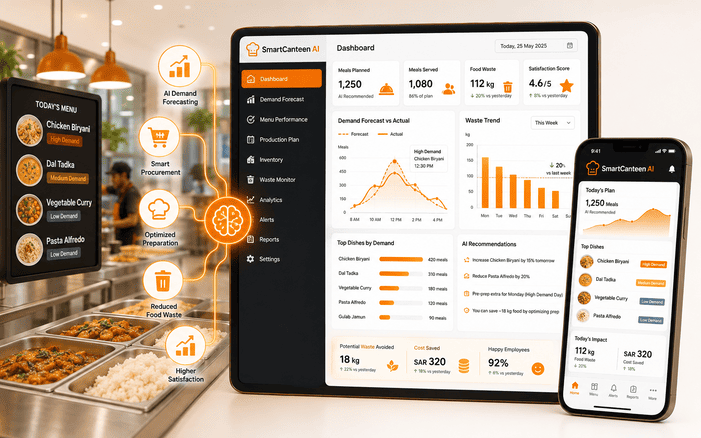
A per-dish quantity recommendation delivered to the kitchen before prep starts, built from real order history rather than a manager's memory of last Tuesday.
Queue Time Prediction
Expected order volume by time slot, so staffing can flex around the actual rush instead of a roster written months in advance.
Waste Tracking
What got thrown away, by dish and by day, turning a vague sense of waste into a specific number the kitchen can actually act on.
Mobile Pre-Ordering
Diners reserve a meal ahead of time, which feeds real advance demand straight into the forecast rather than requiring it to guess.
Dietary Demand Insight
Vegetarian, halal and allergen-safe options tracked separately, so those quantities stop being an afterthought in the prep plan.
Forecast Accuracy Dashboard
Predicted versus actual, visible every day, which is what actually makes the system trustworthy to kitchen staff rather than a black box telling them what to cook.
05How It Works
The forecast runs the night before service, gets checked against what actually happens, and feeds that result straight back into the next prediction.
ORDER HISTORY
  Past sales by dish  ·  day of week  ·  season  ·  calendar events
      │
      ▼
FORECASTING MODEL
  Predicts per-dish demand and order volume by time slot
      │
      ▼
KITCHEN DISPLAY                MOBILE PRE-ORDERS
  Prep quantities before service      Real advance demand feeds forward
      │                                        │
      └──────────────┬─────────────────────────┘
                      ▼
              SERVICE HAPPENS
                      │
                      ▼
          ACTUAL VS PREDICTED
Logged automatically · model retrained on the gap06What the Platform Covers
Kitchen Display
Prep quantities by dish, shown clearly enough to act on without translating a report first.
Mobile Ordering
Diners browse the day's menu, pre-order and pay from their phone before they ever reach the counter.
Queue-Aware Staffing
Predicted rush periods shown to facilities admin, so staffing decisions are based on an actual forecast.
Waste Logging
Leftover quantities recorded by dish, closing the loop between what was cooked and what was actually needed.
Menu Performance
Which dishes consistently over- or under-perform their forecast, which is often the first sign a dish belongs off the rotation.
Admin Reporting
Cost, waste and accuracy trends for facilities management, without assembling a manual report every month.
07Results and Impact
08Conclusion
Food service is one of the few places where a bad prediction turns into something you can literally see in a bin at the end of the day. That immediacy made this project a good test of whether a forecast was actually working, because there was nowhere to hide a wrong number. The lesson that generalises is a familiar one: most operational AI wins come from turning data a business already has into a decision it makes every single day, not from anything exotic in the model itself.
09Project Summary
| SmartCanteen AI | AI forecasting system and mobile ordering app |
| Food service and facilities management | Workplace canteen operator |
| AI-driven prep forecasting and queue prediction | Kitchen staff, diners, facilities admin |
| Food waste and stockouts from guesswork prep | End to end by VirtueNetz |
10Technical Focus Areas
11Questions We Get About This Build
It learns patterns from past order history, by dish, day of week and season, and factors in known calendar effects like holidays or events. The output is a predicted quantity per dish for the next service, which the kitchen uses to plan prep instead of estimating from memory.
Accuracy improves with volume and consistency of past data, and it's never perfect, which is exactly why the forecast dashboard shows predicted versus actual openly rather than presenting a number as gospel. The goal is meaningfully better than a guess, not flawless prediction, and the gap closes over time as the model sees more service days.
No. It removes the guesswork from quantity decisions, but a kitchen manager still handles menu design, quality, and the judgement calls a forecast can't make, like a sudden weather event or a one-off large booking that wasn't in the calendar data.
Yes, and it needs to. Vegetarian, halal and allergen-safe options are forecast as their own categories rather than folded into a general total, because their demand patterns don't track the main menu's patterns closely enough to share a single number.
Every pre-order is a confirmed data point rather than a prediction, so as pre-order volume grows, the forecast for that day gets more accurate automatically. It's the difference between predicting demand and partially observing it in advance.
Past sales records by dish and date are the minimum, and most POS systems already produce this even if nobody has looked at it as a forecasting input before. More history generally means a better starting model, but a kitchen doesn't need years of clean data to get useful predictions early on.
A working forecast on existing order history can be running within a few weeks. The mobile ordering app and kitchen display take longer, and the forecast itself keeps improving for months afterward as it sees more real service days and more of the actual-versus-predicted loop.
Running food service, retail or any operation where over- or under-ordering costs you daily?
We build AI forecasting systems around data you already have. Have a look at the rest of our portfolio, or tell us what you're currently guessing at.
Start a ProjectLet's talk about your project
Tell us what you're currently over-ordering, under-ordering or scheduling by gut feel. An engineer reads it, not a sales script, and you get an honest view on scope before anyone mentions a proposal.
Start a Project
Let's Talk About
Your Project
In our first call, we will talk about your project needs and goals and will share with you how we can rapidly increase the performance and value of your investment.