
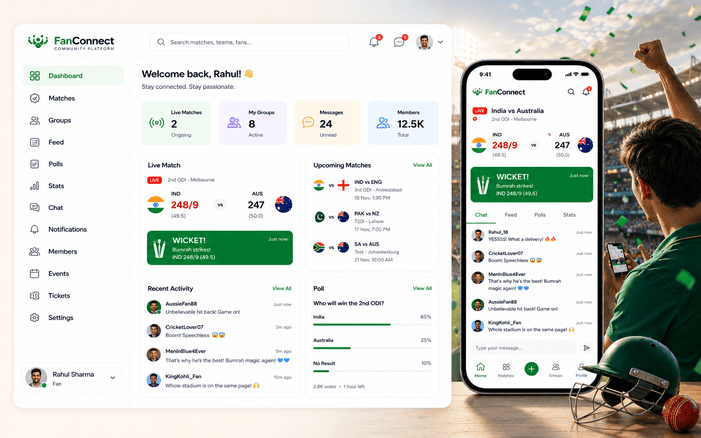
FanConnect Community Platform
01Project Overview
02The Challenge
Building a forum is easy. Building one that survives a Pakistan versus India match is a different engineering problem entirely.
- Traffic arrives all at once Nothing about this load is smooth. A wicket falls, and within seconds thousands of people refresh the same thread, post to it, and hit reply on each other's posts. Average capacity planning is useless here. You size for the spike or you go down during it.
- Forums resist caching The usual answer to read-heavy traffic is aggressive caching. But a live match thread changes every second, and a cached version that is thirty seconds old is worthless to someone watching the game. The interesting work was deciding what could be cached and for how long, page by page.
- The database gets hot in one place On a normal day, load spreads across thousands of threads. During a match it collapses onto one. A single row and its replies become the contention point for the whole platform, which is a very different problem from general high traffic.
- Moderation cannot scale by hiring Emotions run high in sport. Match days produce a spike in reports at exactly the moment the moderation team is smallest and busiest. Volunteers do not scale linearly with traffic.
- Search has to work across years of posts Members expect to find a conversation from three seasons ago. Full-text search over millions of posts is not something you bolt on afterwards without regretting it.
- Every thread is an indexable page A large forum generates enormous numbers of URLs, most of them thin and paginated. Left alone, that becomes a crawl budget problem and drags down the pages that do deserve to rank.
03Our Approach
We planned around the worst hour of the year rather than the average one. That decision shaped almost everything else.
- Design for the spike, not the mean Capacity, caching and queue depth were all sized against match-day peaks. It costs more to sit idle most of the time. It costs a great deal more to be down when your entire membership is online.
- Cache by content type, not by page Thread lists, user profiles, static sections and archived discussions all tolerate very different staleness. Treating them separately let us cache hard where it was safe and stay live where it mattered.
- Take the write path off the request Notifications, counters, mentions and feed updates all moved to background processing. A member's post lands immediately. Everything that fans out from it happens behind the scenes, so a busy queue slows nothing the user can see.
- Give moderators leverage Bulk actions, keyword triggers, trust levels for long-standing members, and a queue that sorts by severity instead of arrival time. The team did not grow. Its reach did.
- Treat search as infrastructure A dedicated index rather than database queries, so search stays fast as the archive grows and stays out of the way of the traffic path.
- Control what gets indexed Canonical rules on pagination, sensible handling of low-value pages, and structured data on discussions so the threads worth ranking are the ones search engines spend their time on.
04What We Delivered
Match-Day Resilience
Layered caching, background job processing and headroom sized for peak. The platform holds through the hours when everybody shows up at once.
Moderation Tooling
A severity-sorted report queue, bulk actions, keyword triggers and trust levels. A small volunteer team covers a community many times its size.
Fast Archive Search
A dedicated search index across years of discussion, so finding a thread from three seasons ago takes about as long as finding one from this morning.
Live Thread Experience
New posts appear without a manual refresh during active matches, which is the difference between a forum and a conversation.
Member Reputation
Profiles, post history and standing that make long-term contributors visible. In a community this size, reputation does a lot of the moderation work for you
Search-Friendly Structure
Clean canonicals, controlled pagination and discussion schema, so the platform earns organic traffic instead of drowning crawlers in near-duplicate pages.
05How It Holds Up
The short version: absorb reads before they reach the database, and push everything that can wait onto a queue.
FANS · web and mobile
  Browse threads  ·  post  ·  react  ·  report
      │
      ▼
EDGE & CACHE LAYER
  Static assets  ·  cached thread lists  ·  archived pages
  most match-day reads never touch the app
      │
      ▼
APPLICATION
  Live threads  ·  posting  ·  auth  ·  moderation actions
      │                                │
      ▼                                ▼
DATABASE                      QUEUE WORKERS
  Threads, posts, users          Notifications · counters
                                 mentions · feed fan-out
      │
      ▼
SEARCH INDEX
Full-text across the archive, kept off the traffic path06What Members Get
Threaded Discussions
Nested replies that stay readable when a thread runs to several thousand posts, which they regularly do during a series.
Live Match Threads
Dedicated threads per fixture with new posts arriving without a refresh, so the conversation keeps pace with the game.
Profiles and Standing
Post history, join date and reputation. Regulars are recognisable, which changes how people behave towards each other.
Notifications
Replies, mentions and followed threads delivered through background workers, so nobody waits on a fan-out.
Archive Search
Full-text search across years of posts, filterable, and fast enough that people actually use it instead of reposting.
Reporting and Appeals
Members flag content, moderators see it ranked by severity, and decisions are logged so the process is defensible.
07Results and Impact
08Conclusion
Community platforms get judged on their worst day, not their average one. Nobody remembers the eleven months a forum worked fine. They remember the night it fell over during a final. So most of the engineering here went into moments that last a few hours a year. That is an awkward thing to justify on a spreadsheet and completely obvious to anyone who has watched a community lose its members overnight.
09Project Summary
| FanConnect Community Platform | Platform architecture, development, scaling |
| Sports, media and online community | Cricket fan community |
| High-availability discussion platform at scale | Fans, moderators, administrators |
| Match-day traffic spikes | End to end by VirtueNetz |
10Technical Focus Areas
11Questions We Get About This Build
The load pattern. Most web applications get traffic that rises and falls gently. A sports community is quiet for hours and then everybody arrives in the same minute. You cannot plan capacity from an average, and the usual caching tricks fight against the thing members actually want, which is content that updates as they watch.
For a small community, you should. Existing forum packages are mature and cheap to run. The calculation changes at scale, when your traffic pattern, moderation needs and search requirements start pulling against what the package assumes. That is usually the point at which people come to us.
Three things, roughly in order of impact. Absorb as many reads as possible before they reach the application. Move anything that can wait, like notifications and counters, onto background queues. Then size the remaining capacity against your peak hour rather than your average one, and accept the cost of idle headroom.
Tooling, mostly. Reports sorted by severity instead of arrival time, bulk actions so one decision can cover fifty items, keyword triggers for the obvious cases, and trust levels so established members are not treated like new accounts. Human judgement stays human. The volume around it gets automated.
It can be very good, and it can be actively harmful, depending on how indexing is controlled. Large forums generate huge numbers of near-duplicate and paginated URLs. Left alone, crawlers spend their budget on those instead of the discussions with real value. Canonical rules and discussion schema decide which way it goes.
It has to. Most match-day traffic arrives from phones, often on unreliable connections, from people watching a game at the same time. That constraint shaped page weight and interaction design more than any desktop consideration did.
A working community can launch relatively quickly. Getting it to survive peak load is the longer part, and it is genuinely iterative, because you learn things during the first big event that no amount of load testing tells you in advance. We plan for that phase rather than pretending it does not exist.
Building a community, marketplace or anything with a peak hour?
We build platforms that hold up when everyone shows up at once. Have a look at the rest of our portfolio, or tell us what your busiest hour looks like.
Start a ProjectLet's talk about your project
Tell us how many people you expect and what happens when they all turn up together. An engineer reads it, not a sales script, and you get an honest view on scope before anyone mentions a proposal.
Start a Project
Let's Talk About
Your Project
In our first call, we will talk about your project needs and goals and will share with you how we can rapidly increase the performance and value of your investment.