Building a mobile app in 2026 is not just a technical task. It is a product decision that shapes how your business grows, retains customers, and competes in an increasingly mobile-first world. Whether you are a startup founder validating your first idea or an established business ready to go digital, understanding the full development journey before you write a single line of code will save you time, money, and frustration.
This guide walks you through every stage of mobile app development in 2026, from discovery and design to launch, maintenance, and growth. You will also find guidance on tech stack choices, team structures, cost factors, and how to choose the right development partner for your project.
What Mobile App Development Means in 2026
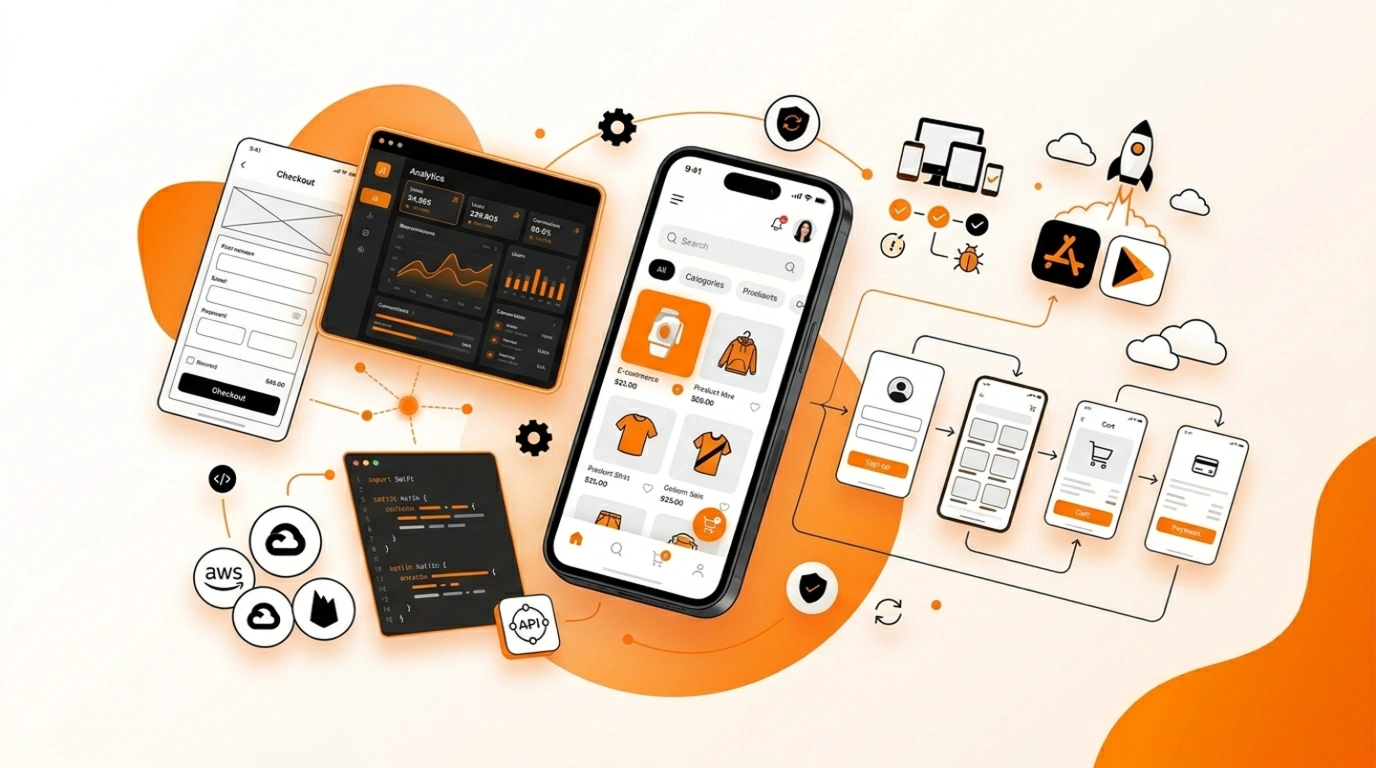
Mobile app development in 2026 is the end-to-end process of designing, building, testing, launching, and maintaining software applications that run on smartphones and tablets. Modern app development goes far beyond writing code. It encompasses product strategy, user experience design, backend architecture, cloud infrastructure, security compliance, and post-launch growth planning.
Apps today are expected to be fast, reliable, personalized, and scalable. A poorly planned app does not just underperform, it damages trust. That is why businesses that invest in a structured development roadmap from day one consistently outperform those that rush straight into building.
Why Modern Apps Need Strategy, Not Just Code
A decade ago, a basic utility app with five screens could succeed on novelty alone. In 2026, users have seen it all. They expect smooth onboarding, intuitive navigation, instant load times, and features that actually solve a problem. Meeting those expectations requires upfront investment in product thinking, not just development hours.
Why Startups and Businesses Need a Structured Roadmap
Without a clear roadmap, app projects drift. Scope expands, budgets blow out, and launch dates slip. A structured development process keeps every stakeholder aligned, reduces rework, and ensures that what gets built matches what the market actually needs.
Why Businesses Are Investing in Mobile Apps in 2026
Mobile usage continues to dominate digital consumption globally. Consumers now expect to book, browse, pay, and communicate entirely from their phones. Businesses that offer a seamless mobile experience retain customers longer and convert at higher rates than those relying solely on websites.
Revenue Opportunities Through Apps
Apps open multiple revenue streams that websites simply cannot match with the same effectiveness: subscriptions, in-app purchases, loyalty programs, push-triggered promotions, and frictionless checkout flows. For service businesses, booking and scheduling apps directly reduce administrative overhead and no-shows.
Local and Regional Momentum in Texas
Across Texas, businesses in healthcare, logistics, retail, and professional services are accelerating their app investments. The state’s fast-growing startup ecosystem and tech-forward business culture make it one of the most active markets for custom app development in the country.
Types of Mobile Apps You Can Build in 2026
Native Apps for iOS and Android
Native apps are built specifically for one platform, using Swift or Objective-C for iOS and Kotlin or Java for Android. They offer the best possible performance and the deepest access to device hardware, including camera, GPS, biometrics, and notifications. Native is the right choice when your product depends on peak performance or platform-specific features.
Cross-Platform Apps with React Native and Flutter
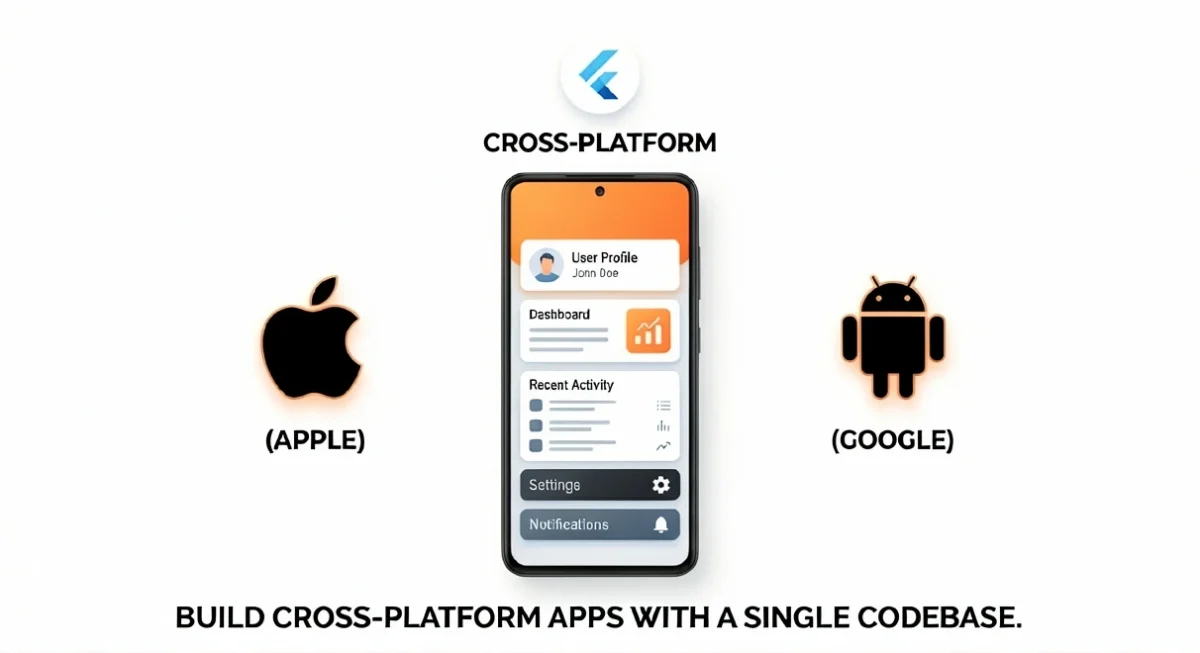
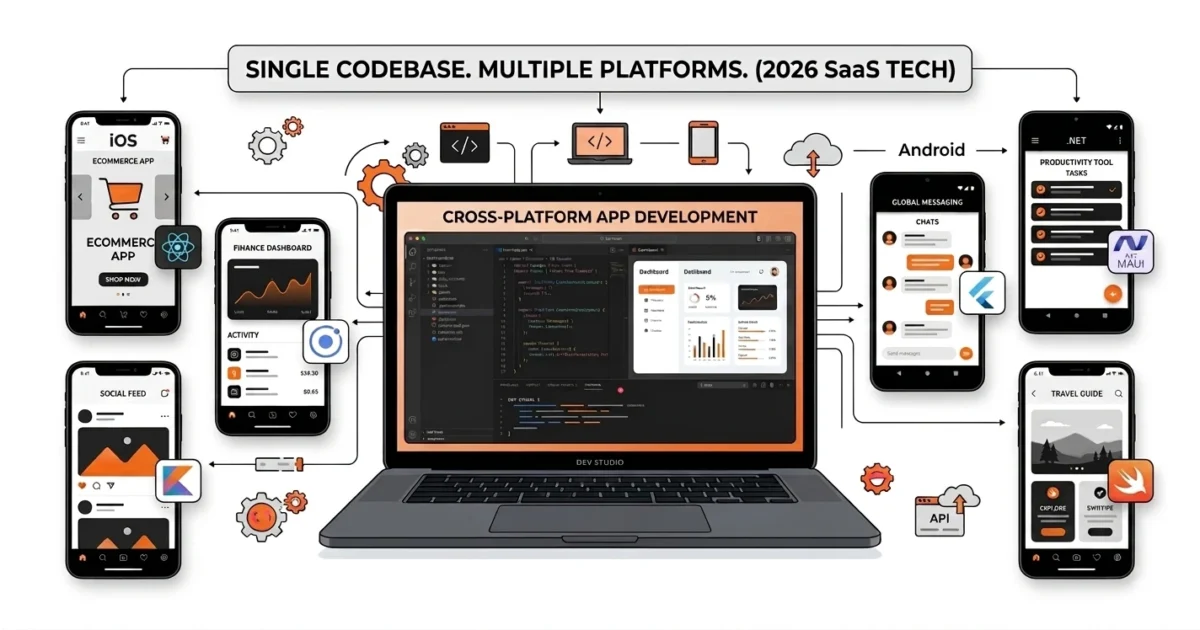
Cross-platform frameworks allow a single codebase to run on both iOS and Android, significantly reducing development time and cost without sacrificing too much performance. [React Native mobile app development] and Flutter are the two dominant frameworks in 2026, each with strong ecosystems and active community support.
Progressive Web Apps and Hybrid Approaches
Progressive web apps (PWAs) run in the browser but behave like native apps on mobile devices. They are ideal for content-heavy products or businesses that want to reach users without requiring an app store download. Hybrid apps use web technology wrapped in a native shell and offer a middle ground for specific use cases.
MVP Apps for Startups and Early Validation
An MVP (Minimum Viable Product) app contains only the core features needed to test your product hypothesis with real users. Starting with an MVP allows startups to gather feedback before committing to a full build. It is the smartest way to reduce risk and spend development budget only on what users actually want.
Mobile App Development Lifecycle: The End-to-End Process
Understanding the mobile app development lifecycle stages helps you set realistic expectations, plan your budget accurately, and make better decisions at every stage of the project. The typical lifecycle moves through eight key phases.
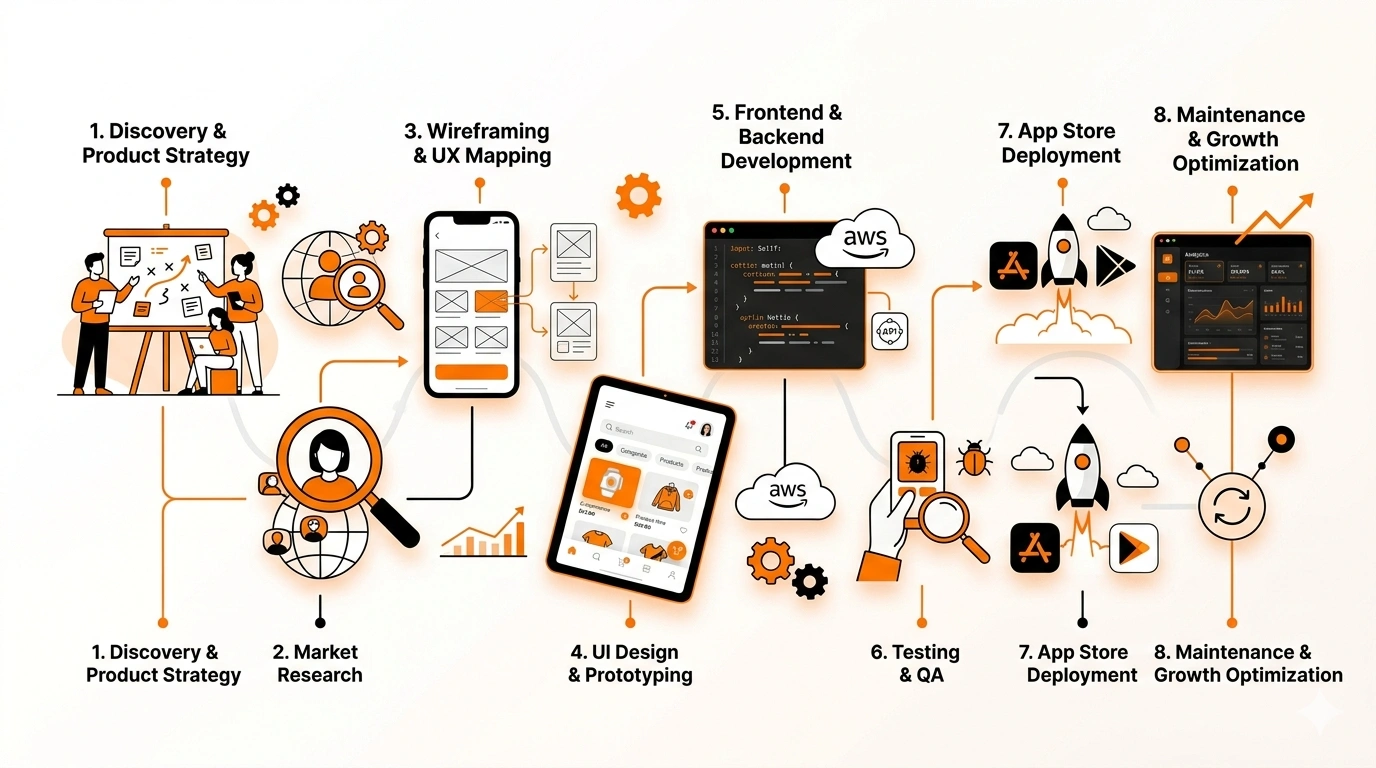
- Discovery and product strategy
- Market research and competitor validation
- Wireframing and UX mapping
- UI design and clickable prototypes
- Frontend and backend development
- Testing and QA
- Deployment and app store launch
- Maintenance, updates, and growth optimization
Each phase builds on the last. Skipping or compressing any of them is one of the most common causes of failed app projects.
Step 1: Planning and Discovery Before You Build
The planning phase is where your app idea becomes a viable product concept. This is where you define what you are building, who it is for, and why they will use it. Skipping this step is the number one reason apps fail after launch.
Define Business Goals and Success Metrics
Before choosing a tech stack or hiring a designer, answer three questions: What problem does this app solve? Who is the target user? How will you measure success? Clear answers to these questions anchor every decision that follows.
Validate Your App Idea Before Investing Heavily
Talk to potential users. Run surveys. Analyze competitors. Look for gaps in existing solutions. If your app idea cannot survive basic market validation, it will not survive launch either. Validation takes days, not months, and it can save you from spending tens of thousands of dollars on the wrong product.
Build an MVP Roadmap Instead of Overbuilding
Prioritize ruthlessly. A well-scoped version one app with three excellent features will outperform a bloated app with fifteen mediocre ones. Define your core user journey, identify the minimum set of features that enables that journey, and defer everything else to version two.
| Pre-Development Checklist |
| ✓ Business goal clearly defined |
| ✓ Target user persona documented |
| ✓ Core features scoped for V1 |
| ✓ Revenue model identified |
| ✓ Launch timeline agreed |
| ✓ Budget range confirmed |
| ✓ Analytics and measurement plan in place |
| Need help validating your app idea before development starts? Talk to our team about building a smart MVP roadmap. |
Step 2: UI/UX Design That Improves Retention
Design is not just about aesthetics. It is the primary driver of whether users return to your app after the first session. Poor UX is the single biggest cause of app uninstalls, and it is almost always fixable before a line of code is written.
Wireframes, Prototypes, and User Journey Mapping
Wireframes are low-fidelity blueprints that map out app structure without visual design. Prototypes add interactivity, allowing you to test flows with real users before development begins. Both save significant time and money by catching structural problems early.
Designing for iOS vs Android Behavior
iOS and Android users have different expectations. Navigation patterns, gesture behaviors, and component styles differ between platforms. A well-designed app respects these platform conventions rather than fighting against them.
UX Mistakes That Increase App Uninstall Rates
Confusing onboarding, too many permission requests upfront, slow load times, cluttered interfaces, and unclear call-to-action buttons are the most common UX failures. Each one can be tested and eliminated before your app reaches the app store.
Step 3: Choosing the Right Tech Stack in 2026
Your tech stack determines your app’s performance ceiling, development speed, long-term scalability, and the pool of developers available to build and maintain it. Choosing the wrong stack early can cost you heavily in rewrites and technical debt later.
Native Development: Swift and Kotlin
Swift is Apple’s language for iOS development. Kotlin is the modern standard for Android. Native stacks deliver the best performance and deepest platform integration. They are the right choice for apps where speed, hardware access, or platform-specific UX are non-negotiable.
Cross-Platform: React Native and Flutter
For most startups and SMBs, cross-platform development offers the best balance of speed, cost, and quality. You can explore the [best mobile app development languages in 2026] in detail to compare options based on your product needs. If you are leaning toward a JavaScript-based team, React Native mobile app development is a natural fit. If you want highly customized UI without performance trade-offs, you may want to hire Flutter app developer talent instead.
Backend, APIs, and Cloud Infrastructure
Your backend determines how your app handles data, authentication, third-party integrations, and scale. Firebase is a popular choice for early-stage apps due to its low setup time and generous free tier. Node.js and Python are strong choices for custom backends. AWS, Google Cloud, and Azure all offer robust mobile backend services that scale as your user base grows.
How to Choose a Stack Based on Your Situation
Budget-conscious startup launching an MVP fast? Cross-platform with React Native or Flutter. Performance-critical app with hardware dependencies? Go native. Team with existing web expertise? React Native is a natural bridge. Need pixel-perfect custom UI? Flutter wins on design flexibility.
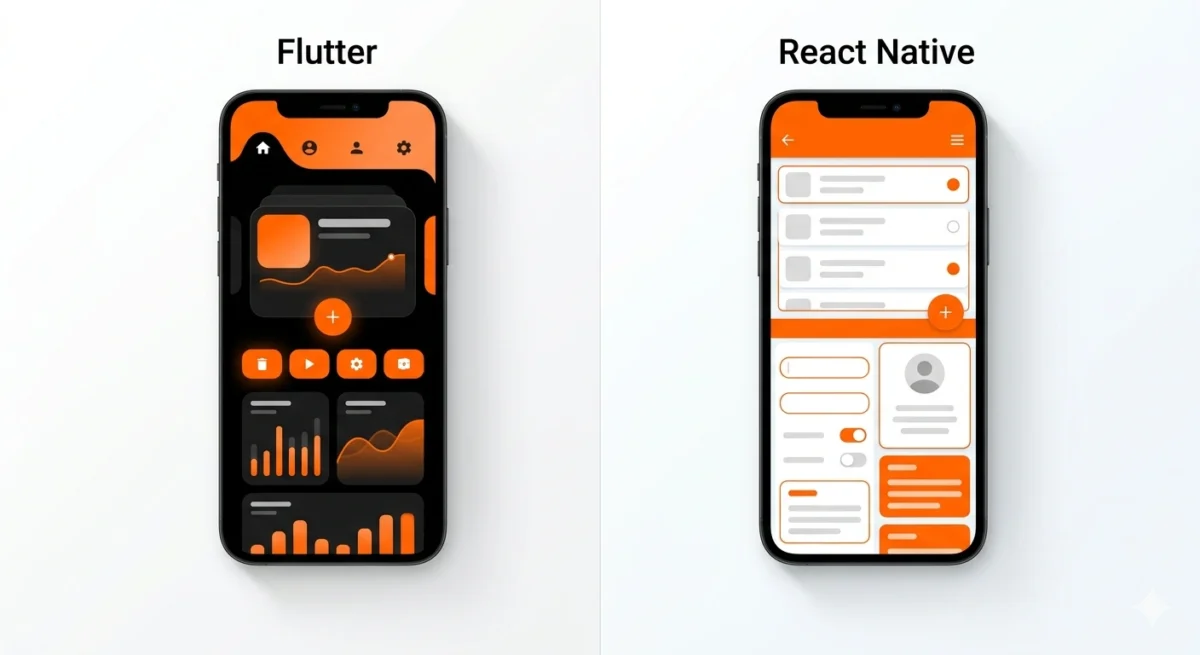
React Native vs Flutter in 2026: Which Is Better for Your App?
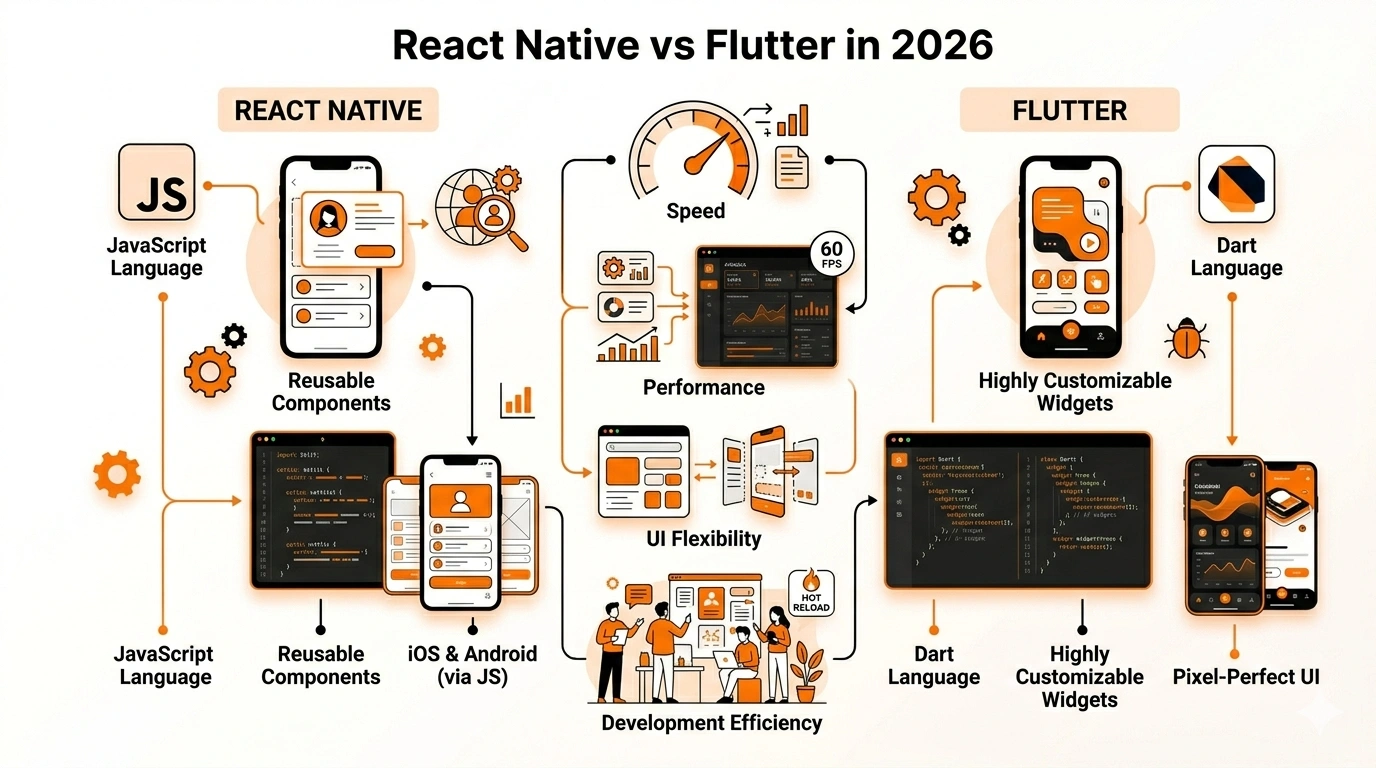
This is one of the most common questions development teams face in 2026. Both frameworks are mature, well-supported, and capable of delivering high-quality apps. The right choice depends on your team, product, and priorities.
| Factor | React Native | Flutter |
| Performance | Near-native | Excellent (compiled) |
| Dev Speed | Fast (JS ecosystem) | Fast (Dart) |
| UI Flexibility | Mostly native UI | Fully custom UI |
| Community | Very large | Growing fast |
| Best For | Web-to-mobile teams | Pixel-perfect UIs |
For most startups, React Native is a safer choice if your development team already knows JavaScript. Flutter is the stronger pick if you need a fully custom visual experience or are targeting both mobile and desktop from a single codebase.
| Not sure which framework fits your product? Get expert guidance on the right mobile app stack for your budget and timeline. |
Step 4: Building the Right Mobile App Development Team
Knowing [how to build a mobile app development team] is just as important as knowing what to build. The right team structure depends on your timeline, budget, and how much internal expertise you already have.
Core Roles in a Mobile App Project
- Product Strategist / Business Analyst: translates business goals into product requirements
- UI/UX Designer: creates wireframes, prototypes, and the full visual design
- Frontend Developer: builds the user-facing app interface
- Backend Developer: builds APIs, databases, and server infrastructure
- QA Engineer: tests every feature before release
- Project Manager: coordinates timelines, communication, and delivery
In-House vs Freelance vs Agency
Building in-house gives you full control but requires significant hiring time and ongoing salary cost. Freelancers are flexible and cost-effective for narrow scopes but harder to manage across a full project. An agency brings an assembled team with defined processes, which reduces coordination overhead and typically accelerates delivery.
When to Outsource App Development
If you need to move fast, lack internal mobile expertise, or want to reduce the risk of an unproven product concept, working with an experienced development partner is often the smarter choice. Outsourcing does not mean losing control. It means leveraging expertise you do not have to build in-house.
Mobile App Development Cost in 2026: What Affects Pricing?
App development costs vary enormously depending on scope, platform choice, team structure, and geographic market. Understanding what drives cost helps you scope your project intelligently and avoid budget surprises. You can find detailed breakdowns for your region at mobile app development cost in Texas and mobile app development cost in Dallas in 2026.
Key Cost Drivers
- App complexity: number of screens, features, and integrations
- Platform: iOS only, Android only, or both
- Framework: native costs more than cross-platform in most cases
- Backend: custom API and database development adds significant cost
- Design scope: custom animations and branded UI components increase hours
- QA and testing: proper testing adds 15 to 25 percent to development hours
- Compliance: HIPAA, GDPR, or PCI requirements add specialized work
- Maintenance: ongoing updates, security patches, and OS compatibility
Rough Ballpark Ranges
A well-scoped MVP can be built in the range of $25,000 to $60,000 depending on complexity and team location. Mid-level apps with both platforms, a custom backend, and a polished UX typically fall between $60,000 and $150,000. Enterprise-grade apps with advanced integrations, compliance requirements, and complex backend architecture can exceed $200,000.
| Want a realistic estimate for your app? Explore Dallas and Texas specific pricing before you start. |
How Long Does Mobile App Development Take in 2026?
Timelines depend on scope, team size, and how well the project is defined upfront. The single biggest cause of timeline overruns is scope creep, adding features mid-project that were not planned at the outset.
| App Type | Typical Timeline | Key Factors |
| MVP App | 6 – 10 weeks | Core features only, one platform |
| Mid-Level App | 3 – 6 months | Both platforms, integrations, admin panel |
| Enterprise App | 6 – 12+ months | Complex backend, compliance, scale |
How Agile Development Shortens Time to Market
Agile development breaks the project into two-week sprints, each delivering a functional piece of the app. This approach allows for faster feedback, earlier detection of issues, and the flexibility to adjust course without throwing away months of work. Most experienced development agencies use agile by default.
Step 5: Testing and QA Before Launch
Testing is not optional. It is the difference between a launch that builds trust and one that generates one-star reviews. A structured QA process covers multiple testing types before your app reaches real users.
- Functional testing: every feature works as intended
- Performance testing: app loads fast and stays stable under load
- Device and OS compatibility: tested on a range of real devices
- Security testing: data is protected and authentication is airtight
- Beta testing: real users test the app and report issues before public launch
Step 6: Launching Your App Successfully
App store submission is a process, not just an upload. Both the Apple App Store and Google Play have review processes, metadata requirements, and policy guidelines that your app must meet before it goes live.
App Store Optimization (ASO) Basics
Your app listing is the first thing a potential user sees. A compelling title, keyword-rich description, high-quality screenshots, and a clear preview video all influence whether someone downloads your app. ASO is the mobile equivalent of SEO and should be planned before launch, not after.
Launch KPIs Every Business Should Track
- Installs and activation rate
- Day 1, Day 7, and Day 30 retention rates
- Crash rate and ANR rate
- Session length and session frequency
- Core feature adoption rate
Post-Launch Maintenance, Updates, and App Growth
Launching your app is the beginning, not the end. Apps that are not actively maintained degrade quickly. New OS versions break old functionality. Security vulnerabilities emerge. User behavior changes. A maintenance plan is as important as the development plan.
- Bug fixes and OS updates: iOS and Android release major updates annually
- Feature releases based on user feedback: your roadmap should evolve with real usage data
- Security patches: vulnerabilities must be addressed quickly
- Analytics review: regular analysis of retention, drop-off, and conversion data drives smart product decisions
Mobile App Security and Compliance Basics in 2026
Security is not a feature you add at the end. It needs to be built into the architecture from the start. In 2026, users are more privacy-conscious than ever, and regulators are more active.
- Use secure authentication methods including biometrics and multi-factor authentication
- Encrypt all data in transit with HTTPS and TLS
- Protect API endpoints with proper authentication and rate limiting
- If handling health data, ensure HIPAA compliance from the architecture stage
- If serving EU users, build GDPR data controls into your product from day one
How AI Is Changing Mobile App Development in 2026
Artificial intelligence is reshaping mobile app development in two distinct ways: as a feature inside apps, and as a tool that accelerates the development process itself.
AI-Powered Features Inside Apps
Personalized content feeds, smart search, predictive recommendations, in-app chatbots, and automated workflows are now accessible to apps of all sizes through APIs and pre-trained models. What required a data science team two years ago can now be integrated in days.
AI-Assisted Development Workflows
Developers in 2026 use AI coding assistants to write boilerplate, generate tests, debug code, and document functions. This meaningfully accelerates development speed, particularly for cross-platform projects. Estimates suggest experienced development teams using AI tooling can deliver similar quality output 20 to 30 percent faster than teams without it.
Where Human Strategy Still Matters
AI can write code. It cannot define the right product strategy, understand nuanced user behavior, or make judgment calls about business trade-offs. Product thinking, stakeholder communication, and user research remain deeply human work.
Common Mobile App Development Mistakes to Avoid
- Building too many features in version one before validating anything
- Ignoring onboarding, the experience that determines whether users ever return
- Choosing a tech stack based on what the team knows rather than what the product needs
- Underestimating testing time and releasing with critical bugs
- Hiring developers based only on price without evaluating process and communication
- Launching without analytics in place, flying blind from day one
How to Choose the Right Mobile App Development Partner
The development partner you choose will have more impact on your project’s success than almost any other decision. Here is what to evaluate before signing anything.
What to Look For
- A portfolio of shipped apps, not just mockups
- Industry experience relevant to your product category
- A defined discovery and planning process before development begins
- Transparent communication and regular progress updates
- Post-launch support and maintenance services
Questions to Ask Before Signing a Proposal
- How do you handle scope changes mid-project?
- Who owns the code and IP at the end of the engagement?
- What does your QA process look like?
- Can I speak with a past client in a similar industry?
- What happens if we need to pivot the product direction?
Red Flags That Signal Project Risk
Be cautious of agencies that skip discovery, promise unusually low costs without explaining trade-offs, cannot show shipped products, or communicate poorly during the sales process. Sales behavior is a preview of delivery behavior.
When to Hire a Mobile App Development Company in Dallas
For businesses in Texas, working with a local development partner offers real advantages beyond proximity. A Dallas-based team understands the regional business landscape, can meet in person during critical planning phases, and is aligned with your time zone for daily communication.
When your project involves complex product strategy, regulated industries like healthcare or fintech, or a significant budget investment, a structured local partnership often outperforms remote freelance arrangements. When you are ready to move from idea to execution, the right time to engage a [mobile app development company Dallas] is before your internal planning process is complete, not after.
Mobile App Development Checklist for 2026
Before starting your mobile app project in 2026, confirm your business goal, target users, MVP features, platform choice, budget, launch timeline, analytics setup, and maintenance plan.
Strategy Checklist
- Business goal and success metrics defined
- Target audience and user personas documented
- Market and competitor research completed
- MVP feature set agreed and locked
Design and UX Checklist
- User journey mapped for core flows
- Wireframes reviewed and approved
- Interactive prototype tested with real users
- Design system and brand guidelines applied
Development and QA Checklist
- Tech stack and architecture finalized
- Backend infrastructure planned and scalable
- All features tested across devices and OS versions
- Security audit completed before launch
Launch and Post-Launch Checklist
- App store listings optimized with ASO in place
- Analytics and crash reporting configured
- Launch KPIs defined and baseline tracked
- Maintenance and update schedule agreedIf you want to understand the complete mobile app development process and lifecycle, this detailed guide can help you get a broader perspective.
FAQs About Mobile App Development in 2026
How much does it cost to build a mobile app in 2026?
Costs range from roughly $25,000 for a well-scoped MVP to $200,000 or more for a complex enterprise app. The biggest cost drivers are feature depth, platform choice, backend complexity, and team experience level.
How long does it take to develop an app?
A focused MVP typically takes 6 to 10 weeks. A mid-complexity app with multiple integrations and both platforms takes 3 to 6 months. Enterprise apps often require 6 to 12 months or more.
Should I choose React Native or Flutter?
Both are strong choices in 2026. Choose React Native if your team has JavaScript expertise or you need a large component ecosystem. Choose Flutter if you need highly customized UI design or want to target mobile and desktop from one codebase.
Do I need a mobile app development company or freelancers?
Freelancers work well for narrow, well-defined tasks. For a full product build, an agency provides a coordinated team, defined process, and accountability that individual freelancers rarely match.
How much does app maintenance cost after launch?
Budget 15 to 20 percent of the original development cost per year for ongoing maintenance. This covers OS updates, security patches, performance improvements, and minor feature additions.
Can a startup build an MVP first and scale later?
Yes, and this is almost always the smarter approach. An MVP lets you validate product-market fit before committing full development resources. The key is designing the MVP architecture to be extensible so scaling does not require a full rebuild.
When should I hire a mobile app development company in Dallas?
The best time to engage a development partner is during your planning phase, before your internal scope is fully locked. A good agency will contribute meaningfully to product strategy and help you avoid expensive scoping mistakes.
Ready to Build Your Mobile App?
Whether you are a startup validating a new idea or a growing business ready to invest in a full product build, the path from concept to launched app is clearer when you have the right team beside you.
| Looking for a reliable mobile app development company in Dallas? Get a tailored consultation for strategy, design, development, and post-launch support. Talk to a Dallas App Development Expert today. |
 ?>
?>
 ?>
?>
 ?>
?>
 ?>
?>
 ?>
?>