
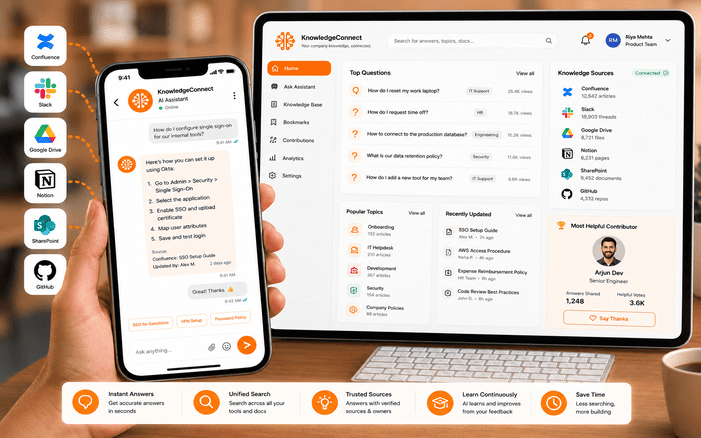
KnowledgeConnect Platform
01Project Overview
02The Challenge
Nothing here was missing. It was just scattered, unsearchable, and slowly draining out of the company every time someone experienced left.
- Knowledge was person-shaped, not document-shaped The real answer to most questions was "ask that one engineer," which is a single point of failure with a name and a calendar full of meetings.
- Keyword search kept missing the point A support agent searching "refund not processing" got nothing useful from a document titled "payment reversal edge cases," even though it was exactly the answer they needed.
- Nobody trusted old answers Documentation existed but nobody knew if it was still accurate, so people asked a person instead of reading it, which defeated the point of writing it down in the first place.
- Support tickets were a graveyard of answers nobody could find again The same question got solved from scratch repeatedly because the previous five resolutions were sitting in closed tickets nobody would think to search.
- New hires took months to become self-sufficient Onboarding meant shadowing someone and absorbing tribal knowledge by osmosis, because there was no single place that actually held it.
- Leadership had no idea what people were actually asking Without a central system, there was no signal on which topics generated the most confusion, so documentation effort went wherever felt urgent instead of where it was actually needed.
03Our Approach
We treated this as a retrieval problem before it was a chatbot problem. A confident wrong answer is worse than no answer, so getting the right source in front of the model mattered more than how polished the response sounded.
- Index everything, trust nothing by default Documentation, tickets, wikis and process notes were pulled into one index, each tagged with source, owner and last-updated date, so staleness could be surfaced rather than hidden.
- Search by meaning, not just keywords Semantic search that matches intent, so "refund not processing" and "payment reversal edge cases" connect even though they share almost no words in common.
- Answer with sources, always Every generated answer links back to the document it came from. If the source is wrong or outdated, that is visible and fixable, rather than baked invisibly into a confident-sounding reply.
- Escalate instead of guessing When the system's confidence in an answer is low, it says so and routes to a human rather than filling the gap with something plausible-sounding and wrong.
- Feed usage back into the content Every question and every answer that got marked unhelpful becomes a signal for what documentation needs writing or fixing, closing a loop that used to depend on someone noticing by accident.
04What We Delivered
AI-Powered Q&A
Ask a question in plain language, get an answer synthesised from the actual documentation, with the source cited. Built through AI development.
Unified Search Index
Documentation, tickets, wikis and notes searchable from one box, ranked by relevance to intent rather than keyword overlap.
Confidence-Aware Escalation
Low-confidence answers route to a human instead of guessing, which is what keeps the system trustworthy rather than merely fluent.
Source Freshness Signals
Every document is tagged with owner and last-updated date, so stale content gets flagged instead of quietly misleading someone.
Knowledge Gap Analytics
A dashboard showing what people actually ask and where answers fall short, turning documentation from guesswork into a prioritised list.
Existing Tool Integration
Connected to the support desk and internal wiki already in use, rather than asking the company to migrate everything into something new.
05How It Works
Underneath the plain-language answer is a retrieval step doing most of the real work. Get the right documents in front of the model and the answer mostly writes itself.
SOURCES
  Docs  ·  wikis  ·  closed tickets  ·  process notes
      │  ingestion and chunking
      ▼
VECTOR INDEX
  Semantic embeddings  ·  source + owner + freshness metadata
      │
      ▼
QUESTION ASKED → RETRIEVAL
  Find the passages that actually answer this, not just match words
      │
      ▼
ANSWER GENERATION
  Synthesise a response grounded in retrieved sources  ·  cite them
      │                              │
      ▼                              ▼
CONFIDENT ANSWER          LOW CONFIDENCE
Delivered with sources Escalated to a human06What the Platform Covers
Natural Language Search
Ask the way you'd ask a colleague, not the way you'd construct a database query.
Cited Answers
Every response links back to its source document, so it can be checked rather than taken on faith.
Ticket History Mining
Past support resolutions become searchable answers instead of buried, one-time fixes.
Role-Based Access
Sensitive internal documentation stays visible only to the teams who should see it.
Content Freshness Alerts
Owners get notified when a document they're responsible for hasn't been reviewed in a while.
Usage Analytics
What people ask, what gets marked unhelpful, and where the real documentation gaps are.
07Results and Impact
08Conclusion
Most companies don't have a knowledge problem. They have a retrieval problem wearing a knowledge problem's clothes. The information usually exists somewhere. It just isn't findable by the person who needs it, at the moment they need it. Getting that right required more discipline around sourcing and honesty about confidence than it did clever generation. The unglamorous half of the build turned out to matter more than the half that looks good in a demo.
09Project Summary
| KnowledgeConnect Platform | AI system design and development |
| Internal tools and knowledge management | Mid-size technology company |
| AI-powered search and Q&A over internal knowledge | All employees, weighted toward support and engineering |
| Scattered, unsearchable institutional knowledge | End to end by VirtueNetz |
10Technical Focus Areas
11Questions We Get About This Build
A wiki is a place to put documents. An AI knowledge base is a system that reads those documents on your behalf and gives you an answer, with the source attached. The wiki still exists underneath, but nobody has to browse it or guess the right search term to get value from it.
By generating answers only from what was actually retrieved from your own documents, rather than from general knowledge, and by exposing its confidence. When retrieval doesn't turn up a strong match, the honest response is to say so and route to a person, not to produce something fluent and wrong.
A pattern where an AI model answers a question using specific documents retrieved for that question, rather than relying purely on what it learned during training. It's the difference between an open-book and a closed-book exam. The retrieval step is what lets the system answer accurately about your company rather than the internet in general.
No, it sits on top of what you already have. Existing docs, wikis and ticket history are indexed rather than migrated or rewritten, and the system integrates with the support desk already in use. The goal is making existing knowledge findable, not replacing where it lives.
Every source is tagged with an owner and a last-updated date, so staleness is visible rather than hidden inside a confident answer. Where two documents genuinely conflict, that gets surfaced too, which is usually the first sign a piece of documentation needs a real owner to resolve it.
Yes, through role-based access control. The retrieval layer only surfaces documents a given user is permitted to see, so the system respects the same permission boundaries your existing tools already enforce.
Indexing and a working search experience come together relatively quickly. The part that takes longer, and matters more, is tuning retrieval quality and confidence thresholds against your actual content, which only becomes clear once real people start asking real questions.
Sitting on knowledge nobody can find when they need it?
We build AI systems that answer from your own documentation, with sources attached. Have a look at the rest of our portfolio, or tell us where your knowledge currently lives.
Start a ProjectLet's talk about your project
Tell us where your team's knowledge actually lives today and what people keep having to ask each other. An engineer reads it, not a sales script, and you get an honest view on scope before anyone mentions a proposal.
Start a Project
Let's Talk About
Your Project
In our first call, we will talk about your project needs and goals and will share with you how we can rapidly increase the performance and value of your investment.