Building a mobile app in 2026 is both exciting and overwhelming. You have one big question to answer before writing a single line of code: which framework should you use?
The cross-platform development space has matured a lot. But it has also gotten more crowded, more opinionated, and more complex. Not every framework that was popular three years ago is still the right choice today.
This guide breaks down the top 5 cross-platform app development frameworks in 2026 with honest, practical insights. No fluff. No hype. Just the facts you need to make a smart decision, whether you are a developer or a business owner.
If you want to skip the comparison and talk to experts directly, a trusted cross-platform app development company help you pick the right stack for your goals.
What is Cross-Platform App Development?
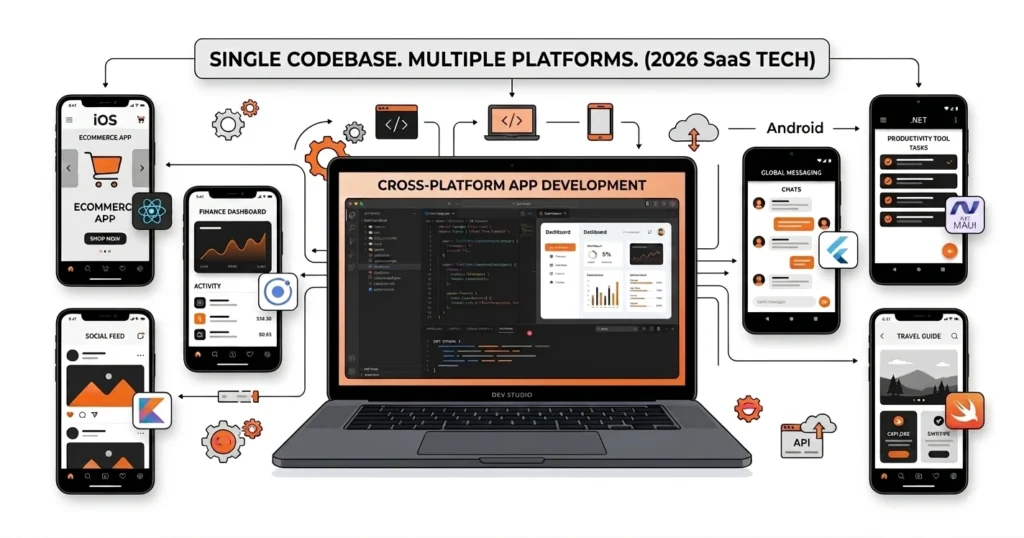
Cross-platform app development means writing one codebase that runs on multiple operating systems, mainly iOS and Android, and sometimes the web or desktop too.
Instead of building a separate native app for each platform, you share most of your logic and UI across all of them. This saves time, reduces cost, and makes maintenance easier.
It sits in the middle ground between fully native vs progressive web apps comparison and is the go-to choice for most product teams today.
Why Businesses Prefer Cross-Platform Development in 2026
The reasons have not changed dramatically, but they have become more compelling as frameworks matured.
- Cost efficiency: One team, one codebase, two platforms.
- Faster time to market: Ship to both iOS and Android at the same time.
- Easier maintenance: Fix a bug once, fix it everywhere.
- Stronger AI tooling: AI code assistants like GitHub Copilot work better with popular cross-platform languages like Dart and JavaScript.
- Talent availability: Easier to hire JavaScript and Dart developers than platform-specific specialists.
TOP 5 FRAMEWORKS IN DETAIL
1. Flutter
Created by: Google | Language: Dart | First Released: 2018
What is Flutter?
Flutter is Google’s open-source UI toolkit for building natively compiled applications from a single codebase. It does not use native components at all. Instead, it draws everything on its own canvas using the Skia (now Impeller) rendering engine.
This is what makes Flutter stand out. The UI looks identical on every platform because Flutter controls every pixel itself.
Key Features
- Uses Dart, a fast and easy-to-learn language
- Hot reload for instant UI changes during development
- Impeller rendering engine (replaces Skia) for smoother animations
- Supports iOS, Android, Web, Windows, macOS, and Linux from one codebase
- Massive widget library with Material and Cupertino design systems
Pros
- Best visual consistency: Pixel-perfect UI across all platforms
- Fast performance: Compiled to native ARM code, not interpreted
- Growing ecosystem: dev has thousands of packages in 2026
- Strong AI tooling: GitHub Copilot and Google’s own Gemini integrations understand Dart well
Cons
- Dart is not widely known outside the Flutter world
- Larger app sizes compared to React Native
- Web support is still not production-grade for complex SPAs
- Accessing native platform APIs requires writing platform channels in Swift/Kotlin
Best Use Cases
- Consumer apps that need rich, custom UI
- Fintech and health apps that need pixel-perfect design
- Startups launching on both iOS and Android simultaneously
When NOT to Use Flutter
Avoid Flutter if your app is heavily dependent on native platform APIs, requires advanced WebView capabilities, or your team has deep JavaScript expertise with no desire to learn Dart.
| Real-World Insight: Google Pay, BMW’s app, and eBay Motors all use Flutter. These are not small experiments. They are production apps serving millions of users, which is strong validation of Flutter’s enterprise readiness. |
2026 Relevance and Future Outlook
Flutter is the fastest-growing cross-platform framework by GitHub stars and developer surveys in 2025-2026. Google’s continued investment and the Impeller engine upgrade make it the safest bet for new projects today.
Want to understand whether Flutter is right for your business? Read this guide on why choose Flutter for app development.
2. React Native
Created by: Meta (Facebook) | Language: JavaScript / TypeScript | First Released: 2015
What is React Native?
React Native lets you build mobile apps using JavaScript and React. Unlike Flutter, it uses actual native components. When you write a button in React Native, it renders an actual iOS or Android button under the hood.
This gives it a more native feel by default, and it integrates more naturally with platform conventions.
Key Features
- JavaScript / TypeScript, the most popular languages in the world
- Uses native UI components, not a custom renderer
- New Architecture (JSI + Fabric) launched for better performance
- Huge npm ecosystem available
- Expo framework makes setup and deployment much easier in 2026
Pros
- Largest talent pool: Almost every JavaScript developer can pick this up quickly
- Fastest hiring: Easiest framework to staff a team for
- Mature ecosystem: 10+ years of libraries, tools, and community knowledge
- Expo in 2026: Expo SDK 52+ has made React Native significantly easier to work with
Cons
- The New Architecture migration is still not 100% complete for all third-party libraries
- JavaScript bridge historically caused performance bottlenecks (improving but not fully resolved)
- Debugging can be painful for complex native interactions
- Not ideal for apps with heavy animations or complex custom graphics
Best Use Cases
- E-commerce and marketplace apps
- Social networking apps
- Business productivity tools
- Teams already using React for web development
When NOT to Use React Native
Skip React Native if your app requires real-time high-performance graphics (like games), heavy use of device hardware, or if you need absolute UI pixel-control across platforms.
| Real-World Insight: Meta, Microsoft (Outlook Mobile), Shopify, and Coinbase use React Native. Meta’s continued investment in the New Architecture in 2025-2026 signals a strong future for this framework. |
2026 Relevance and Future Outlook
React Native is not declining, but Flutter has caught up in developer satisfaction. React Native still wins on hiring ease and ecosystem size. If you already have a JavaScript team, there is almost no reason not to consider it.
3. Kotlin Multiplatform (KMP)
Created by: JetBrains | Language: Kotlin | Stable Release: 2023 / Growing in 2026
What is Kotlin Multiplatform?
Kotlin Multiplatform is different from Flutter and React Native. It does not try to replace your entire app. Instead, it lets you share business logic, network calls, and data handling across iOS and Android while keeping platform-specific UI written natively.
Think of it as a code-sharing layer, not a full UI framework. Each platform still has its own native UI.
Key Features
- Share only business logic, keep native UIs
- Full interoperability with Swift and Objective-C on iOS
- Jetpack Compose Multiplatform extending UI sharing gradually
- Backed by JetBrains and growing Google support
Pros
- Best native performance: UI is still fully native on each platform
- No UI compromises: Designers and platform teams keep full control
- Strong for Android teams: Kotlin developers can start immediately
- Enterprise credibility: Netflix, Philips, and VMware use KMP in production
Cons
- Steep learning curve for iOS developers unfamiliar with Kotlin
- You still need separate iOS and Android UI developers
- Jetpack Compose Multiplatform is not yet fully stable for all platforms
- Smaller community than Flutter or React Native
- Harder to hire for: Kotlin Multiplatform specialists are genuinely rare
Best Use Cases
- Large enterprises with existing native teams
- Apps where native look-and-feel is absolutely non-negotiable
- Teams with strong Kotlin background expanding to iOS
When NOT to Use KMP
If you are a startup or small team without native iOS and Android developers, KMP will cost you more, not less. It is designed for teams that already have platform expertise and want to reduce code duplication, not eliminate it.
| Real-World Insight: Cash App by Block uses KMP. This is a high-frequency financial app with millions of daily active users. KMP lets them share complex financial logic while keeping the UI native and platform-appropriate. |
2026 Relevance and Future Outlook
KMP is growing steadily. JetBrains’ roadmap for Compose Multiplatform suggests more shared UI capabilities by late 2026. It is a serious option for enterprises, but not a beginner framework.
4. Ionic
Created by: Ionic Team (now Ionic / Capacitor) | Language: JavaScript, TypeScript | First Released: 2013
What is Ionic?
Ionic is a hybrid app framework that wraps a web app inside a native container. It uses web technologies like HTML, CSS, and JavaScript to build the entire app, then packages it using Capacitor (or the older Cordova) to access native device features.
If you know web development, Ionic lets you ship a mobile app with almost no learning curve.
Key Features
- Build with Angular, React, or Vue inside a mobile shell
- Capacitor provides native API access (camera, GPS, push notifications)
- Works on iOS, Android, and web from the same codebase
- Large component library mimicking native UI patterns
Pros
- Lowest barrier to entry: Web developers can ship mobile apps immediately
- Fastest development speed: Especially for simple to moderately complex apps
- Strong PWA support: Build once, deploy anywhere including browsers
- Low cost: Great for MVPs and internal enterprise tools
Cons
- Performance is noticeably worse than Flutter or React Native on low-end devices
- Animations and complex interactions can feel laggy on older Android phones
- Does not feel truly native, even with native-style components
- Less suitable for apps requiring complex background tasks or heavy computation
Best Use Cases
- Internal enterprise tools and dashboards
- MVPs and early-stage product validation
- Web apps that need basic mobile presence
- Content-heavy apps without complex animations
When NOT to Use Ionic
Avoid Ionic if your app has high performance requirements, complex animations, real-time data processing, or if users are on low-end budget Android devices. The WebView performance gap becomes very obvious in those scenarios.
| Real-World Insight: Ionic works well for enterprise apps used on company-issued devices where performance is controlled. For public consumer apps competing with native experiences, it often falls short of user expectations. |
2026 Relevance and Future Outlook
Ionic is stable but not growing in the same way Flutter and KMP are. The Capacitor ecosystem is solid. Ionic remains a practical choice for specific use cases, but it is not the framework you would choose for a flagship consumer product in 2026.
5. Xamarin / .NET MAUI
Created by: Microsoft | Language: C# / .NET | Xamarin Deprecated: 2024 | .NET MAUI: Active in 2026
What is .NET MAUI?
Xamarin was Microsoft’s cross-platform mobile framework. It has been officially replaced by .NET MAUI (Multi-platform App UI), which extends the concept to desktop platforms as well.
.NET MAUI lets you build apps for iOS, Android, macOS, and Windows from a single C# codebase. It is Microsoft’s answer to Flutter, but aimed specifically at the .NET enterprise world.
Key Features
- Single codebase for iOS, Android, macOS, and Windows
- Full .NET 8 integration and C# language support
- Strong Visual Studio tooling
- Access to native APIs through .NET bindings
Pros
- Perfect for .NET shops: Teams already using C# can move to mobile without learning a new language
- Enterprise integration: Deep Microsoft ecosystem compatibility (Azure, Active Directory, Teams)
- Desktop + mobile: One framework for Windows, macOS, iOS, and Android
Cons
- Xamarin officially reached end-of-life in May 2024, forcing migration to MAUI
- .NET MAUI still has stability and tooling issues compared to more mature frameworks
- Community is shrinking compared to Flutter and React Native
- Hiring MAUI developers is genuinely difficult in 2026
- Performance issues reported on complex UI-heavy applications
Best Use Cases
- Microsoft-centric enterprises already invested in the .NET ecosystem
- LOB (Line of Business) apps that also need Windows desktop versions
- Teams with existing C# developers who cannot justify a new language
When NOT to Use .NET MAUI
If you do not have existing .NET infrastructure or C# expertise, there is almost no good reason to choose MAUI over Flutter or React Native in 2026. The learning cost is the same, but the ecosystem and community are significantly smaller.
| Real-World Insight: Microsoft itself uses .NET MAUI for some internal productivity apps. However, very few new startups are choosing MAUI as their first framework. It is predominantly a choice made by organizations with existing Microsoft investments. |
2026 Relevance and Future Outlook
MAUI is holding steady but not growing. Microsoft continues to invest in it, but developer survey data consistently shows it lagging well behind Flutter and React Native in adoption and satisfaction scores. Proceed with caution unless you are already deep in the .NET world.
Framework Comparison at a Glance (2026)
Here is a side-by-side look at how these five frameworks compare across the metrics that matter most.
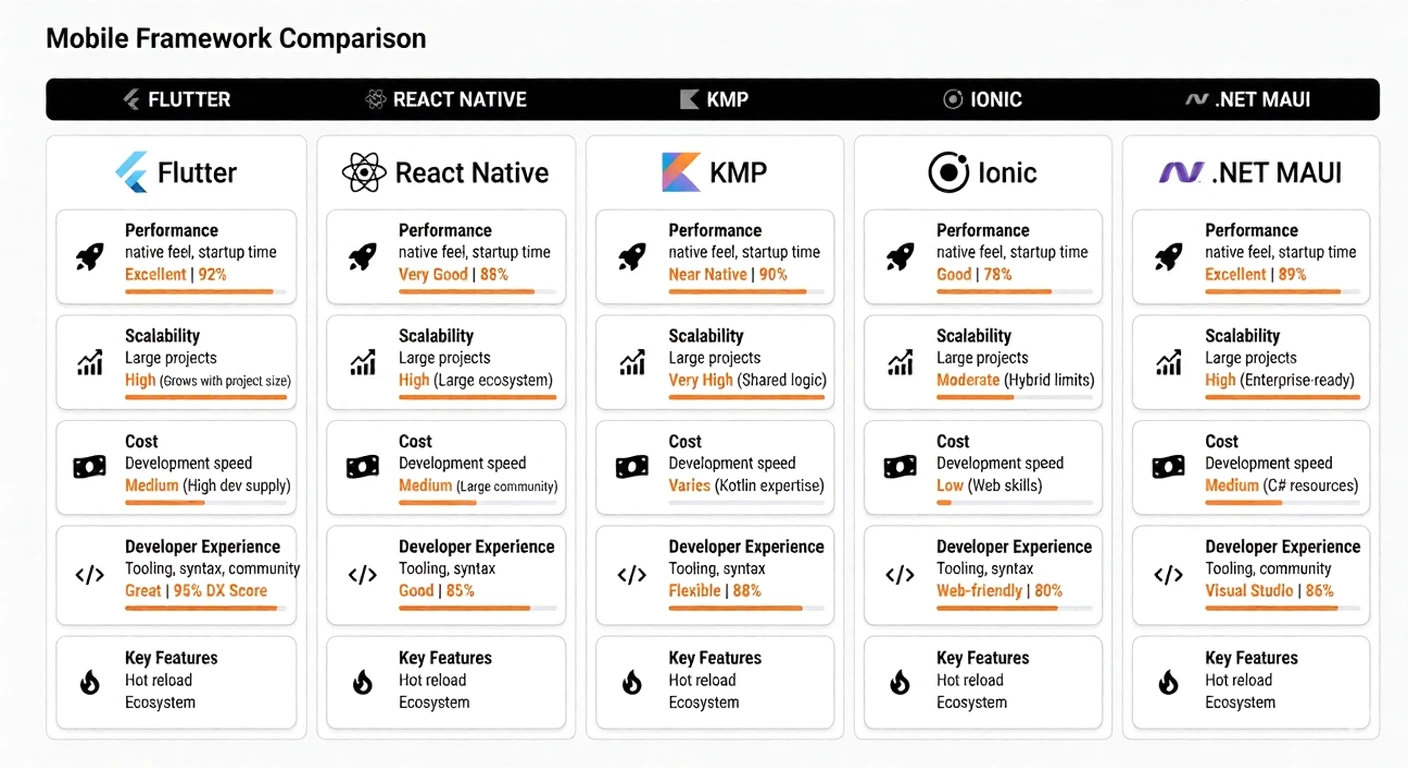
Note: Ratings are based on community surveys, developer feedback, and industry usage data from 2025 to early 2026. Individual results may vary depending on your specific use case and team expertise.
Which Framework Should You Choose?
There is no single right answer. But here is a practical decision guide:
| Choose Flutter if: You want the best UI consistency, fast performance, and are open to learning Dart. Best for startups and consumer apps. |
| Choose React Native if: Your team already knows JavaScript, and you need to hire quickly. Best for e-commerce, social, and business apps. |
| Choose KMP if: You have existing native iOS/Android teams and want to share business logic without compromising on UI quality. Best for enterprises. |
| Choose Ionic if: You need a fast MVP and your team is entirely web-based. Best for internal tools and basic consumer apps. |
| Choose .NET MAUI if: Your team is a Microsoft .NET shop and you need to support Windows alongside mobile. Otherwise, consider Flutter first. |
Still unsure? Our team at Virtuenetz offers hybrid app development services that help you evaluate and implement the right stack for your business goals.
What Most Blogs Will Not Tell You
Hiring Difficulty is Real
Flutter and React Native are easy to hire for in most markets. Kotlin Multiplatform specialists are rare and expensive. Xamarin/.NET MAUI developers are even harder to find, and that shortage will only get worse as the community shrinks.
Performance on Low-End Devices
Flutter performs best on low-end Android devices because it does not rely on WebView or JavaScript interpretation. React Native with the New Architecture is close. Ionic falls behind noticeably on budget phones.
Maintenance Cost Over Time
Flutter’s single codebase with no native UI dependencies makes it the cheapest to maintain long-term. React Native requires more dependency management and occasional native fixes. KMP and Ionic sit in the middle. MAUI teams often find hidden costs in tooling bugs.
Impact of AI Tools in 2026
AI coding assistants favor Flutter and React Native because of the sheer volume of training data available. Dart and JavaScript are well understood by LLMs. Kotlin Multiplatform and C# for MAUI have decent but noticeably less comprehensive AI support.
Startup vs Enterprise Suitability
- Startups: Flutter and React Native, almost every time. Speed and cost matter most.
- Enterprises: KMP for native-quality at scale. MAUI if you are already a .NET shop.
- Agencies: React Native and Ionic for fast delivery across multiple client projects.
Common Mistakes to Avoid When Choosing a Framework
- Choosing based on hype alone, without evaluating your team’s existing skills
- Ignoring hiring difficulty, especially for KMP and MAUI
- Assuming all cross-platform frameworks perform equally on older Android devices
- Picking Ionic for a performance-sensitive consumer app
- Migrating from Xamarin to MAUI without evaluating if Flutter might be a better long-term investment
- Not factoring in the long-term maintenance cost when comparing upfront development cost
External References
- Flutter Official Documentation: dev (Google) for the most up-to-date framework specs and changelog
- React Native New Architecture: dev (Meta) for details on JSI, Fabric, and TurboModules
- Kotlin Multiplatform Roadmap: org (JetBrains) for the official KMP and Compose Multiplatform roadmap
Final Thoughts
The cross-platform app development landscape in 2026 is more mature than ever. Flutter has emerged as the overall leader for new projects. React Native holds its ground with the largest community. Kotlin Multiplatform is the enterprise choice for native quality at scale. Ionic serves a specific purpose for web-first teams. And .NET MAUI is the safe port for Microsoft-committed shops.
The right framework is the one that fits your team, your timeline, your budget, and your users’ expectations. There is no universal winner.
Take time to evaluate each option carefully, factor in talent availability in your region, and think about the 3-year maintenance picture, not just the launch timeline.
| Need expert guidance on choosing the right framework?The team at Virtuenetz specializes in cross-platform mobile development and can help you build the right product on the right stack, from day one. |
Frequently Asked Questions
Flutter is generally the leading choice for new projects, thanks to its consistent UI, strong performance, and fast-growing ecosystem. React Native is the best alternative for teams that already know JavaScript. The right choice still depends on your team’s skills, budget, timeline, and long-term maintenance needs.
Flutter offers pixel-perfect UI consistency and strong performance on low-end devices because it renders its own interface. React Native uses native components and has a larger talent pool, which makes hiring easier. Choose Flutter for custom, design-heavy apps and React Native if your team already works in JavaScript or React.
No. Xamarin officially reached end-of-life in May 2024, and Microsoft replaced it with .NET MAUI. Teams still on Xamarin should plan a migration to .NET MAUI, or evaluate alternatives like Flutter or React Native if they have no existing .NET investment.
Native development builds a separate app for each platform using Swift for iOS and Kotlin for Android. Cross-platform development uses one shared codebase for multiple platforms, which reduces cost and time to market. Native apps still offer the deepest platform integration and the best performance for hardware-heavy features.
Flutter and React Native are the best fit for most startups. Both let a single small team ship to iOS and Android at the same time, with lower development and maintenance costs. Kotlin Multiplatform suits enterprises with existing native teams, and Ionic suits simple MVPs.