
Most articles about Flutter read like a press release. They list benefits, skip trade-offs, and leave you no closer to a real decision.
This post is different. It is written for business owners, CTOs, and startup founders who need to make an actual call on their tech stack. By the end, you will know exactly when Flutter makes sense, when it does not, and what most consultants quietly leave out.
What Is Flutter, in Plain Terms
Flutter is an open-source UI framework built by Google. It lets developers write one codebase and deploy apps to iOS, Android, web, and desktop from that single source.
The language it uses is called Dart. It is not widely used outside of Flutter, which matters more than most people admit (we will get to that).
What makes Flutter different from other cross-platform tools is that it does not rely on native UI components. Instead, it draws every pixel itself using its own rendering engine (Skia, now Impeller). This gives Flutter unusual visual consistency across platforms.
Why Businesses Are Choosing Flutter in 2026
The core business case for Flutter has not changed, but the maturity of the ecosystem has. In 2026, Flutter is no longer a bet. It is a proven choice for a wide range of product types.
Here is why business leaders keep picking it:
One team, two stores. A single Flutter developer can ship to both iOS and Android. For startups watching their burn rate, this alone can cut early-stage development costs by 30 to 50 percent compared to running two separate native teams.
Faster time to market. Flutter’s hot reload feature lets developers see code changes instantly without restarting the app. Iteration cycles are shorter. MVPs ship faster. This is especially valuable when you are validating an idea and speed matters more than perfection.
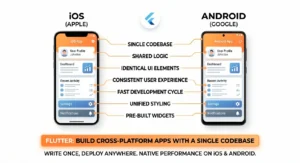
Consistent UI across platforms. Because Flutter renders its own components, your app looks and feels identical on an iPhone and a Samsung Galaxy. Brand-conscious companies appreciate this. You define the design once; it holds everywhere.
Strong backing from Google. Flutter is not a community experiment. Google uses it internally for products like Google Pay. The framework receives regular updates, and enterprise-grade support is increasingly available.
Growing plugin ecosystem. By 2026, the Flutter pub.dev package library has matured significantly. Most common integrations (payments, maps, analytics, push notifications) have stable, well-maintained packages.
If you want to understand where Flutter fits in a broader cross-platform strategy, it helps to first explore cross-platform development strategies to frame the decision properly.
Key Advantages Worth Understanding in Depth
Performance That Is Close to Native (But Not Identical)
Flutter apps compile to native ARM code. They do not use a JavaScript bridge the way React Native traditionally did. This removes one of the biggest historical performance bottlenecks in cross-platform development.
In practice, Flutter apps feel fast. Animations run at 60fps or 120fps on supported hardware. For most business apps, fintech tools, e-commerce platforms, and internal enterprise tools, Flutter’s performance is indistinguishable from native.
Where it gets more nuanced is in computationally heavy scenarios. Video processing, augmented reality, or complex hardware interactions may require platform-specific code anyway.
UI Quality and Custom Design
Flutter gives design teams a lot of creative freedom. Because the framework renders everything itself, you are not constrained by what the OS decides a button should look like.
This is a real advantage for product teams with strong brand identities. You can build pixel-perfect designs that hold across Android and iOS without fighting the platform’s default components.
Cost Efficiency Over Time
The cost savings are not just in the initial build. Maintenance is cheaper too. Bug fixes, feature additions, and UI updates go into one codebase instead of two. Over a 2 to 3 year product lifecycle, this often saves more than the initial development cost differential.
Real Limitations of Flutter (What Most Blogs Skip)
Here is where most Flutter content fails you. Benefits are easy to list. Limitations require honesty.
Dart Is a Niche Language
Dart is clean and easy to learn, but almost no developer has used it before encountering Flutter. If you need to scale your team quickly, you are hiring people to learn a new language. That adds ramp-up time and can shrink your hiring pool.
In markets where mobile development talent is already limited, this is a real constraint.
App Size Is Larger Than Native
A minimal Flutter app is larger than an equivalent native app. The Flutter engine ships with the app. For users on limited data plans or older devices, this can matter. It is not a dealbreaker for most apps, but it is worth knowing before you commit.
Deep Platform Integration Has Gaps
Flutter handles 80 to 90 percent of platform integration needs well. The remaining 10 to 20 percent, things like deep Bluetooth control, certain accessibility implementations, or cutting-edge OS-specific features, often require writing platform-specific code in Kotlin or Swift anyway.
If your app’s core value proposition depends on deep hardware access, Flutter may add complexity rather than reduce it.
The Web and Desktop Story Is Still Maturing
Flutter’s mobile performance is solid. Its web and desktop output has improved, but remains behind mature web frameworks for web-first products. If you are building primarily for web, Flutter is not the obvious choice.
When Flutter Is the Right Choice
Flutter tends to perform best in these scenarios:
- You are building an app for both iOS and Android and want a single codebase
- Your product needs a polished, custom UI that must look identical across platforms
- You are an early-stage startup prioritizing speed and cost
- Your app is UI-heavy but not deeply reliant on hardware-specific features
- You want to expand to desktop or web later without a full rebuild
- Your team is small and cross-functional rather than platform-specialist
When NOT to Choose Flutter
This matters as much as the above list.
- Your app is primarily a web application. Use a dedicated web framework instead.
- Your core feature requires deep, cutting-edge integration with a specific platform (latest iOS widgets, watchOS, CarPlay). Native will give you faster access and fewer workarounds.
- You cannot afford the Dart learning curve on a tight hiring timeline.
- You need maximum startup performance and your target users are on low-end Android devices with limited storage.
- Your team already has strong native iOS and Android expertise. Switching to Flutter may slow you down, not speed you up.
Flutter vs React Native: A Practical Comparison
React Native uses JavaScript and compiles to native components. Flutter uses Dart and draws its own UI. This is the fundamental difference, and it shapes almost every other trade-off.
Performance. Flutter has historically held an edge here because it avoids the JavaScript bridge. React Native’s New Architecture (JSI and Fabric) has narrowed this gap significantly, but Flutter still tends to win on animation-heavy or visually complex apps.
Hiring. React Native wins. JavaScript developers are far more common than Dart developers. If your company already has web developers, React Native may let them contribute to mobile work with a shorter ramp-up.
UI consistency. Flutter wins clearly. React Native renders using native components, which means subtle platform differences appear in the UI. Flutter’s self-rendered approach eliminates this.
Ecosystem maturity. Both are mature in 2026. React Native has been around longer and has a larger community. Flutter’s package ecosystem has caught up for most use cases.
When to pick React Native instead. If you have a JavaScript-heavy team, a strong web presence that shares logic, or a tight hiring timeline in a competitive talent market, React Native often makes more practical sense even if Flutter is technically stronger in some areas.
For a deeper look at how both compare within the wider landscape, see this breakdown of top cross-platform app development frameworks.
What Most Blogs Don’t Tell You About Flutter
The Hidden Costs of Flutter Adoption
Dart training time. Even strong developers need 4 to 8 weeks to become productive in Dart and Flutter’s widget model. Budget for this.
Plugin quality varies widely. The pub.dev ecosystem is large, but not all packages are equally maintained. Choosing the wrong plugin for a critical feature can create technical debt that is expensive to unwind later.
State management is still fragmented. Flutter has no single official state management solution. Teams use BLoC, Riverpod, Provider, GetX, and others. Disagreement on this can create inconsistency across a codebase, especially on larger teams.
Enterprise tooling is still catching up. If your organization relies heavily on specific enterprise CI/CD tools, monitoring platforms, or testing frameworks, verify Flutter integration before committing. Gaps still exist.
Long-Term Maintenance Considerations
Flutter’s rapid update cadence is both a strength and a risk. Major versions have historically introduced breaking changes. An app built on Flutter 2 required non-trivial work to migrate to Flutter 3.
Plan for ongoing maintenance. Flutter apps are not set-and-forget.
Also consider this: if your original development partner or team dissolves, finding Flutter developers for ongoing support is harder than finding JavaScript or native developers. This is a real business continuity risk for companies that do not have in-house mobile expertise.
Common Mistakes Businesses Make When Choosing Flutter
Choosing Flutter because it’s cheaper upfront. Cost efficiency is real, but it comes with strings. If you underinvest in quality architecture early, Flutter’s flexibility can create a messy codebase that becomes expensive to maintain.
Not validating plugin availability early. Teams often discover mid-project that a critical integration has no mature Flutter plugin. Always audit your third-party integration list before choosing your framework.
Assuming one codebase means zero platform-specific work. It does not. Budget for some native code. Flutter’s platform channels exist for a reason.
Hiring Flutter developers by resume keyword alone. Flutter and Dart skill quality varies widely. A developer with two years of Flutter experience is not the same as one with two years of senior-level Flutter architecture experience. Vetting matters more than usual.
Skipping UX testing on both platforms. A Flutter app may look identical on iOS and Android, but users’ expectations of how apps should behave differ. Test with real users on both platforms before launch.
Your Final Decision Guide
Ask yourself these questions before deciding:
- Are you targeting both iOS and Android from day one? If yes, Flutter is worth serious consideration.
- Does your app require deep, cutting-edge native integrations? If yes, evaluate native or hybrid approaches first.
- Can you find and afford Dart-experienced developers in your market? If not, React Native or native may be more practical.
- Is your timeline tight and your team small? Flutter’s single codebase advantage compounds here.
- Is your app primarily web-facing with a mobile companion? Consider a web framework for the core and evaluate Flutter separately for mobile.
- Are you building a long-term product, not just an MVP? If yes, budget for maintenance, upgrades, and the Dart talent pipeline.
If the majority of your answers point toward Flutter, it is likely the right choice. If several answers point away from it, do not force the decision based on Flutter’s marketing narrative.
Working with an experienced team helps here. Exploring custom mobile app development services or hybrid app development solutions with the right partner can clarify which approach fits your specific product, budget, and timeline.
Conclusion
Flutter is one of the strongest cross-platform frameworks available in 2026. It is fast, visually powerful, and genuinely cost-efficient for the right use cases. But it is not the right choice for every product.
The businesses that succeed with Flutter are the ones that evaluated it honestly, understood its constraints alongside its strengths, and built with a clear architectural plan from the start.
The ones that struggle are usually those who chose it on hype alone, skipped the trade-off analysis, and treated “one codebase” as a solution to every problem.
Make the decision deliberately. The framework you choose in month one shapes everything that follows.
If you are planning a cross-platform app, choosing the right tech stack early can save significant cost and time.
Frequently Asked Questions
Flutter is an open-source UI framework by Google that allows developers to build apps for iOS, Android, web, and desktop using a single codebase. It uses Dart and renders its own UI, ensuring consistent design across platforms while compiling into native code for strong performance.
Yes, Flutter is a mature and reliable choice in 2026. It offers fast development, cost efficiency, and near-native performance. It is especially useful for startups and businesses targeting both iOS and Android with limited resources and a need for quick time to market.
Flutter’s biggest advantages include a single codebase, faster development with hot reload, consistent UI across devices, and reduced maintenance costs. It also provides strong performance by compiling to native code and gives design teams full control over the app’s look and feel.
Flutter uses Dart, which has a smaller talent pool, making hiring harder. Apps are usually larger in size compared to native ones. Some advanced features require platform-specific code, and its web support is still less mature than dedicated web frameworks.
Flutter offers better UI consistency and smoother animations, while React Native benefits from a larger developer community using JavaScript. If your team already uses JavaScript, React Native may be easier. For highly customized, design-focused apps, Flutter is often the better option.