
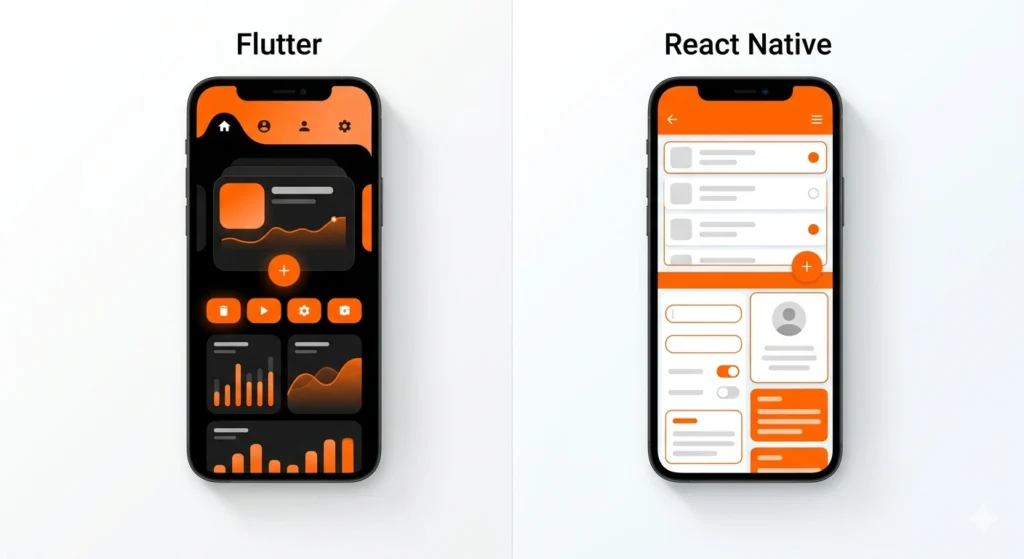
Every year, thousands of businesses face the same question: Flutter or React Native?
In 2026, that question has become even more important. The mobile app market is larger and more competitive than ever. Users expect fast, smooth, and feature-rich apps. And businesses want to build those apps without burning through their budget.
Both Flutter and React Native are top-tier cross-platform frameworks. Both let you build apps for iOS and Android using a single codebase. But they are not the same. They have different strengths, different limitations, and they suit different types of projects.
This guide gives you a real, honest comparison. Not a surface-level list of pros and cons. Real insights based on how these frameworks perform in actual business environments in 2026.
If you want a broader overview first, our guide on top cross-platform app development frameworks is a good starting point.
A Quick Overview: What Are Flutter and React Native?
Flutter
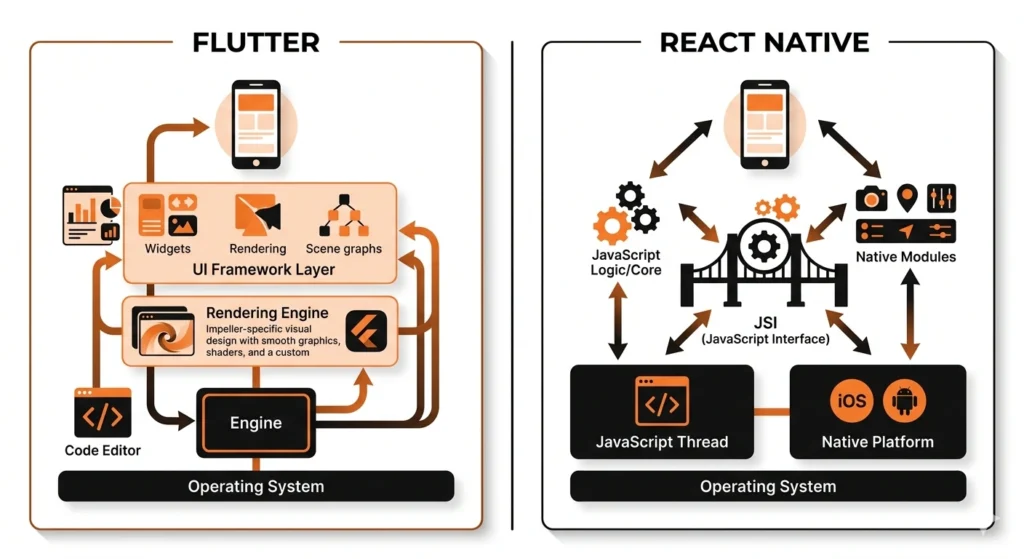
Flutter is Google’s open-source UI toolkit. It was launched in 2018 and has grown rapidly. Flutter uses the Dart programming language and comes with its own rendering engine called Skia (now transitioning to Impeller).
The key thing about Flutter is that it does not use native components. It draws everything itself. This gives you pixel-perfect consistency across iOS, Android, web, and desktop.
React Native
React Native is Meta’s (formerly Facebook) open-source framework. It was released in 2015 and has a massive community behind it.
React Native uses JavaScript and React. It works by bridging JavaScript code to native components. This means your app looks and feels more like a native app on each platform.
In 2024, Meta introduced the New Architecture for React Native, which replaced the old bridge system with JSI (JavaScript Interface). This made React Native significantly faster and more stable.
Flutter vs React Native Performance in 2026
Performance is one of the biggest factors businesses care about. Slow apps lose users. Let’s break this down honestly.
Flutter Performance
Flutter compiles to native ARM code. Its Impeller rendering engine (fully stable in 2026) eliminates shader compilation jank, which was a major issue in earlier versions. Flutter renders at a consistent 60fps or 120fps depending on the device.
Because Flutter draws its own UI instead of using native components, it has predictable rendering performance. There is no translation layer between your code and what the user sees on screen.
React Native Performance
With the New Architecture fully adopted by 2026, React Native has closed much of the performance gap. JSI allows JavaScript to communicate with native modules synchronously, without the old asynchronous bridge.
React Native also supports Hermes, a JavaScript engine optimized for mobile. Combined, these improvements make React Native significantly faster than it was two or three years ago.
Performance Under Scale
Here is something most comparison blogs skip: how do these frameworks perform as your user base grows?
- At 10,000 to 50,000 users, both frameworks perform well with no major differences.
- At 100,000 to 500,000 users, Flutter tends to show more consistency in UI rendering. Complex animations and heavy UI interactions hold up better.
- At 1 million or more users, the performance bottleneck often shifts from the framework to the backend, database, and API design. The framework matters less at this stage.
One important note: React Native’s performance is heavily tied to how well your JavaScript logic is optimized. Poorly written JavaScript can slow down the entire app. Flutter’s Dart code is generally more predictable in this regard.
Side-by-Side Comparison: Flutter vs React Native 2026
| Factor | Flutter | React Native |
| Language | Dart | JavaScript / TypeScript |
| Rendering | Own engine (Impeller) | Native components via JSI |
| Performance | High and consistent | High after New Architecture |
| UI Consistency | Pixel-perfect across platforms | Platform-native look and feel |
| Learning Curve | Medium (Dart is new for most) | Lower (JS developers adapt quickly) |
| Community Size | Large and growing | Very large and mature |
| Hot Reload | Yes | Yes |
| Web and Desktop Support | Yes (stable) | Limited (web is experimental) |
| AI SDK Support (2026) | Growing rapidly | Mature and widely available |
| Google Play / App Store Ready | Yes | Yes |
Developer Ecosystem and Hiring Challenges
This is one of the most overlooked factors when businesses choose a framework. You need developers. And finding the right ones matters.
Flutter Talent Pool
Dart is not a widely known language outside of Flutter development. In 2026, Flutter developers are more available than in 2021, but they are still harder to find than JavaScript developers.
If you need to hire quickly, the Flutter talent pool is smaller. You may pay a premium for experienced Flutter engineers. However, developers who know Flutter tend to be dedicated to the ecosystem and often produce cleaner, more structured code.
React Native Talent Pool
React Native uses JavaScript and React. There are millions of JavaScript developers worldwide. If your team already has React or web developers, they can transition to React Native much faster.
This is a significant advantage for startups that need to move quickly and scale their team without extensive retraining.
Long-Term Maintenance Costs
Here is another insight that most blogs miss entirely.
- Flutter apps tend to have lower long-term maintenance costs. The codebase is more structured, the UI is self-contained, and platform-specific issues are rare.
- React Native apps can accumulate technical debt faster, especially if third-party native modules are used. When iOS or Android updates their APIs, you may need to update or replace those modules.
- The React Native New Architecture has improved this, but legacy React Native codebases still carry this risk.
For a three-year to five-year product horizon, this is a meaningful difference in total cost of ownership.
Cost and Time-to-Market Analysis
Development Cost
Both frameworks reduce development cost compared to building separate native apps. You write one codebase and deploy to iOS and Android.
However, the total cost depends on your team’s existing skill set.
- If your team knows JavaScript: React Native is cheaper to start. Less training, faster onboarding.
- If you are hiring fresh: Flutter and React Native are roughly equal in initial developer cost.
- If UI complexity is high: Flutter often saves time because its widget system is powerful and self-contained.
Time to MVP
React Native generally allows faster MVP delivery for teams with JavaScript experience. The vast npm ecosystem means more ready-made packages.
Flutter is catching up. Its pub.dev package repository has grown significantly. For most standard app features, packages are available.
For a typical MVP, expect similar timelines. The difference usually comes down to team familiarity, not the framework itself.
Real-World Use Cases: Which Framework Fits Your Business?
Flutter for Fintech and Banking Apps
Financial apps need consistent UI, strict security, and smooth performance. Flutter is an excellent choice here.
Apps like Google Pay use Flutter for parts of their interface. The ability to control every pixel on screen is valuable when you need to build complex custom UI components like transaction dashboards, charts, and data visualizations.
Flutter also allows you to enforce a consistent brand identity across iOS and Android, which matters in high-trust industries like finance.
React Native for eCommerce Apps
eCommerce apps often benefit from React Native’s native look and feel. Shoppers expect platform-familiar interactions, like iOS-style navigation or Android back gestures.
React Native’s large ecosystem also includes mature libraries for payment processing, push notifications, analytics, and deep linking. For a product-focused team that wants to move fast, this ecosystem is a real advantage.
Our hybrid app development services are built around choosing the right framework for each client’s specific context.
Flutter for SaaS and B2B Tools
SaaS apps targeting multiple platforms benefit greatly from Flutter’s cross-platform reach. Flutter supports iOS, Android, web, macOS, Windows, and Linux from a single codebase.
For a B2B tool that needs to run on tablets, desktops, and phones, Flutter is often the better choice. React Native’s desktop and web support is still not as mature.
React Native for Content and Media Apps
Apps focused on content consumption, such as news readers, podcasts, or video platforms, often integrate deeply with native device features. React Native’s bridge to native modules makes this integration straightforward.
The mature ecosystem around media playback, camera access, and push notifications gives React Native an edge here.
AI Integration in Apps: A 2026 Differentiator
In 2026, AI features are no longer optional. Users expect smart recommendations, voice input, image recognition, and real-time personalization. How do Flutter and React Native handle AI?
Flutter and AI
Flutter’s AI integration ecosystem has matured significantly. Google’s focus on on-device AI through TensorFlow Lite and ML Kit is directly accessible in Flutter apps. Google’s own Gemini AI APIs are well-documented for Flutter integration.
Flutter’s strong rendering engine also makes it easier to build AI-powered visual interfaces, like real-time camera filters or interactive data dashboards.
React Native and AI
React Native benefits from the broader JavaScript and Node.js AI ecosystem. OpenAI, Anthropic, and other AI providers all have JavaScript SDKs that work well with React Native.
For apps that need to call LLM APIs or integrate conversational AI, React Native has a slight edge simply because the JavaScript AI SDK ecosystem is so mature.
In practice, both frameworks can handle AI integration well. The choice depends more on which AI tools your team is already using.
Scalability: Which Framework Handles Growth Better?
Scalability is not just about the framework. It is about your architecture, your backend, and your team. But the framework does play a role.
Flutter Scalability
Flutter’s Dart language encourages a more structured, typed coding style. This makes it easier to maintain and scale codebases as teams grow. The widget-based architecture is modular and clean.
For large teams working on a single app, Flutter’s structure reduces the risk of inconsistent code quality.
React Native Scalability
React Native’s JavaScript foundation makes it flexible, but that flexibility can become a problem at scale. Without strong TypeScript discipline and code standards, large React Native codebases can become messy.
The good news is that TypeScript adoption in React Native is now near-universal. Teams that enforce TypeScript and good architecture patterns can scale React Native apps effectively.
Hidden Limitations: What Most Blogs Do Not Tell You
Flutter Limitations
- Dart is not widely used outside of Flutter. If you stop using Flutter, your Dart knowledge does not transfer well.
- Flutter apps have a slightly larger binary size because the framework bundles its own rendering engine.
- Third-party plugin quality can be inconsistent. Some plugins are maintained by the community, not by Google.
- Flutter’s web support has improved but still lags behind dedicated web frameworks for complex web applications.\
React Native Limitations
- The New Architecture is still being adopted. Some older third-party libraries have not updated to support it, causing compatibility issues.
- JavaScript debugging can be harder than Dart debugging, especially for native module issues.
- React Native’s UI can look and behave differently on iOS and Android if not carefully managed.
- Long-term maintenance of apps using many native modules can become expensive as platform APIs evolve.
When NOT to Use Flutter
- When your team is entirely JavaScript-based and has no bandwidth to learn Dart
- When you need deep integration with many platform-specific native features through third-party modules
- When your primary deliverable is a web application, not a mobile app
- When you need to hire quickly from a large, immediately available talent pool
When NOT to Use React Native
- When your app has highly complex, custom UI animations that need pixel-perfect consistency across platforms
- When you are building for desktop and web in addition to mobile, and need a single codebase for all
- When your team has no JavaScript experience and you are starting from scratch
- When long-term maintenance predictability is more important than initial development speed
Future-Proofing Your Decision in 2026
Technology choices are long-term investments. Here is how to think about future-proofing.
Flutter’s Future
Google has heavily invested in Flutter. It is the default framework for new Google apps. Impeller rendering, Dart’s evolution, and Flutter’s expansion to embedded platforms (like cars and smart TVs) show a clear long-term direction.
Flutter’s trajectory in 2026 is strong. If Google continues its investment, Flutter is a safe long-term bet.
React Native’s Future
Meta’s continued investment in the New Architecture and Hermes engine signals that React Native is here to stay. The sheer size of the JavaScript developer community means React Native will always have community support.
React Native’s integration with the broader JavaScript ecosystem, including AI, web, and server-side tools, makes it highly adaptable.
If you are evaluating your options, speaking with an experienced cross-platform app development company can help you align the right framework with your specific business goals.
Flutter vs React Native for Startups: The Honest Answer
Startups need speed, flexibility, and cost efficiency. Here is a direct recommendation.
Choose React Native if: Your team has JavaScript experience, you need to move fast, and your app follows standard UI patterns.
Choose Flutter if: Your app needs a unique, custom UI, you are building for multiple platforms including desktop, or you prioritize long-term code quality over initial speed.
For most early-stage startups building a mobile-first product, React Native will get you to market faster. But if your MVP requires a distinctive visual experience or cross-platform reach beyond mobile, Flutter is worth the extra learning curve.
You can also read more about why choose Flutter for app development if you are leaning toward Flutter and want a deeper dive into its advantages.
Flutter vs React Native for Enterprise Apps
Enterprise apps have different priorities. Security, scalability, cross-platform support, and long-term maintainability matter more than speed to market.
Flutter has an edge for enterprise because of its consistent behavior across platforms and its strong typing through Dart. Large teams benefit from its structured architecture.
React Native works well for enterprise too, especially when the enterprise already has a large JavaScript team. Companies like Microsoft and Shopify have used React Native for large-scale internal apps.
The key for enterprise is governance: whoever builds the app needs to enforce strict code standards. Both frameworks can perform well at enterprise scale with the right discipline.
Which Framework Should You Choose? Decision Guide
| Your Situation | Recommended Framework |
| JavaScript team, fast MVP needed | React Native |
| Complex custom UI, brand consistency critical | Flutter |
| Need iOS + Android + Desktop + Web | Flutter |
| eCommerce or content app with native feel | React Native |
| Fintech or data-heavy dashboard app | Flutter |
| Small startup, quick hire needed | React Native |
| Long-term SaaS product, multi-platform | Flutter |
| AI chatbot or LLM-integrated app | React Native (JS AI SDKs) |
| Government or high-security enterprise app | Flutter |
| Already have React/web developers | React Native |
For official documentation and benchmarks, you can refer to the Flutter documentation at flutter.dev and the React Native documentation at reactnative.dev. Meta’s announcement of the New Architecture is available on the official React Native blog.
For a broader look at how cross-platform compares to purely native approaches, our native vs progressive web apps comparison covers the trade-offs in detail.
Make the Right Choice for Your Business
In 2026, both Flutter and React Native are mature, capable frameworks. Neither is objectively better. Each has clear strengths and clear trade-offs.
Flutter wins when you need design consistency, multi-platform reach, and a structured long-term codebase. React Native wins when you have a JavaScript team, need to hire fast, or want the closest thing to a native experience through a cross-platform framework.
The worst decision is choosing based on hype alone. The best decision is one that matches your team’s skills, your product’s requirements, and your business’s timeline.
If you are planning to build a scalable cross-platform app, our Mobile App Development services help businesses choose the right framework and development approach based on their goals, budget, and long-term scalability.
Frequently Asked Questions
There is no universal winner. Flutter is better for apps that need a highly custom UI, consistent cross-platform experience, and long-term maintainability. React Native is better for teams with JavaScript experience, fast hiring needs, and apps that benefit from a native look and feel. The right choice depends on your specific project requirements and team capabilities.
Flutter generally has more consistent rendering performance because it uses its own engine and does not rely on native components. React Native has significantly improved performance with its New Architecture and JSI, closing most of the gap. For most real-world apps, both are fast enough. The performance difference matters most for apps with complex animations or heavy UI interactions.
For startups with JavaScript developers, React Native is typically faster to market. For startups building visually unique apps or targeting multiple platforms from day one, Flutter is the stronger investment. The most important factor is your existing team’s skill set.
Both can scale to millions of users. Flutter’s Dart language and structured architecture make large codebases easier to maintain. React Native scales well with TypeScript and disciplined architecture. At the framework level, scalability is less about which tool you use and more about how you use it.
Flutter apps tend to have lower long-term maintenance costs. The self-contained rendering engine means fewer platform-specific breakages when iOS or Android updates. React Native apps that use many native modules may require more frequent maintenance as platform APIs evolve. Over a three-to-five-year horizon, this can be a meaningful cost difference for complex apps.
React Native has the larger hiring pool because it uses JavaScript and React, which are already widely used in web development. Businesses can often hire React Native developers faster and at lower cost compared to Flutter developers. Flutter’s talent pool has grown significantly, but experienced Dart developers are still less common in the market.